You’ll find that wearable ECGs deliver impressive sensitivity rates up to 94% for detecting atrial fibrillation, but they can’t match the diagnostic precision of clinical-grade systems when it comes to complex arrhythmia analysis. While devices like KardiaMobile achieve 98.7% specificity, single-lead wearables struggle with false positives exceeding 10% and miss critical conditions like STEMI that require multi-lead analysis. The continuous monitoring advantage helps capture intermittent rhythms that clinical visits often miss, though regulatory standards haven’t caught up with the technology’s rapid advancement.
Sensitivity and Specificity Performance Differences Between Wearable and Clinical ECGs
When you’re evaluating heart rhythm monitoring technology, the performance gap between wearable and clinical ECGs becomes apparent through their sensitivity and specificity measurements.
Wearable devices can achieve impressive sensitivity rates, with some reaching 94% for atrial fibrillation detection—comparable to clinical standards. However, you’ll find that specificity presents a bigger challenge for consumer devices.
Clinical ECGs typically deliver high specificity due to controlled testing conditions and precise interpretation. Many wearable ECGs struggle with low specificity, generating false positives that lead to unnecessary medical visits and patient anxiety.
Notable exceptions exist, like KardiaMobile’s 98.7% specificity when paired with smartphone apps. This specificity gap becomes particularly problematic in populations with low disease prevalence, where false positives considerably outweigh true cases. The challenge is compounded by the fact that not all wearable devices are FDA cleared, raising additional concerns about their effectiveness compared to standard 12-lead ECGs.
AI-Enhanced Diagnostic Accuracy in Modern Wearable ECG Devices
As wearable ECG technology evolves, artificial intelligence has emerged as a game-changer for diagnostic accuracy, bridging the performance gap between consumer devices and clinical standards.
AI algorithms now achieve 95-99% sensitivity in detecting arrhythmias, often matching or surpassing human clinician accuracy. Deep learning techniques like CNNs and RNNs identify patterns invisible to human interpretation, enabling early detection of atrial fibrillation and coronary artery disease. Studies show AI demonstrates superior classification of twelve rhythm classes compared to average cardiologist interpretations.
| AI Capability | Performance Level | Clinical Impact |
|---|---|---|
| Arrhythmia Detection | 95-99% sensitivity | Early stroke prevention |
| Pattern Recognition | Beyond human capability | Hidden disease detection |
| Predictive Analytics | Mortality forecasting | Proactive intervention |
You’ll benefit from AI’s predictive capabilities that analyze ECG data to forecast cardiovascular risks and mortality. However, data quality challenges and clinical workflow integration remain hurdles requiring ongoing research and validation.
Single-Lead Limitations Vs Multi-Lead Clinical ECG Capabilities
When you’re relying on single-lead wearable ECGs, you’ll encounter significant diagnostic blind spots that can compromise patient safety.
Complex arrhythmias like ventricular tachycardia with aberrancy or atrial fibrillation with rapid ventricular response often can’t be accurately distinguished from less dangerous rhythms using just one lead’s perspective.
You’ll also find that STEMI detection becomes unreliable since single-lead devices can’t provide the spatial localization and confirmation that multi-lead clinical systems offer through their extensive 12-lead analysis. The narrow data view inherent in single-lead systems fundamentally limits their ability to capture the comprehensive electrical activity patterns needed for definitive cardiac diagnosis.
Complex Arrhythmia Detection Gaps
Though single-lead wearable ECG devices like the Apple Watch and KardiaMobile have revolutionized personal heart monitoring, they can’t match the diagnostic power of multi-lead clinical systems when detecting complex arrhythmias.
While your smartwatch excels at catching atrial fibrillation with 96% accuracy, it struggles considerably when you’re dealing with more intricate heart rhythm disorders. The gap becomes particularly evident with complex conditions requiring thorough analysis.
Here’s where single-lead devices fall short:
- Supraventricular Tachycardia Detection – These devices can’t reliably analyze rapid heart rhythms originating above the ventricles.
- Atrial Flutter Recognition – KardiaMobile shows poor sensitivity for atrial flutter without additional leads.
- QT Interval Measurement – Single-lead technology lacks precision for measuring essential timing intervals.
You’ll need multi-lead clinical ECGs for accurate diagnosis of these complex arrhythmias, as physician interpretation remains vital for proper assessment. The high negative predictive value of wearable devices makes them particularly reliable for ruling out cardiac arrhythmias when results are normal.
STEMI Diagnostic Insufficiency
Beyond rhythm disorders, wearable ECGs face even greater limitations when confronting life-threatening conditions like STEMI (ST-elevation myocardial infarction).
Your single-lead wearable device can’t capture the thorough cardiac activity patterns that STEMI diagnosis requires. While clinical 12-lead ECGs provide anterior, lateral, inferior, and posterior views essential for detecting heart attacks, your wearable ECG offers only a narrow glimpse.
You’ll miss critical diagnostic markers like Q-waves and specific ST-elevation patterns that require multiple leads to identify.
Clinical ECGs deliver the multi-lead precision and hospital-grade sensitivity necessary for accurate STEMI detection, interpreted by trained professionals who can recognize subtle but life-threatening changes. Traditional ECGs use 12 electrodes for comprehensive heart activity measurement and are considered the ‘gold standard’ for clinical settings.
Your wearable device serves as an early warning system, but it can’t replace clinical ECG equipment when diagnosing heart attacks.
STEMI Detection Accuracy: Wearable Vs Standard 12-Lead Systems
You’ll find that modern four-electrode wearable ECG systems achieve remarkable diagnostic performance, with recent studies demonstrating 100% agreement with standard 12-lead ECGs in STEMI detection.
This perfect concordance positions these devices as viable emergency triage tools, potentially revolutionizing pre-hospital cardiac care by enabling rapid, accurate diagnosis outside clinical settings. The high mortality rate associated with STEMI makes early detection capabilities particularly critical for patient outcomes.
However, you must understand that this clinical equivalence validation comes from limited studies, and the broader applicability across diverse patient populations and emergency scenarios requires further investigation.
Perfect Diagnostic Agreement
When researchers compared the AngelUS® 4-electrodes-12-leads wearable system against standard 12-lead ECG in 70 consecutive STEMI patients at a cathlab, they discovered something remarkable: perfect diagnostic agreement between both methods.
Independent cardiologists, blinded to the ECG sources, assessed each patient’s tracings separately. The results were striking:
- Cohen’s kappa statistic reached 1.0 – indicating perfect agreement between wearable and standard ECG interpretations
- 100% correlation with coronary angiography – both ECG methods matched the gold-standard imaging results completely
- Zero diagnostic discrepancies – every STEMI inclusion and exclusion decision aligned perfectly between systems
You’re witnessing clinical equivalence in real-time cardiac monitoring. This validation demonstrates that advanced wearable technology can match traditional diagnostic accuracy when properly designed and implemented in acute care settings. However, clinical trials reveal that both single-lead and 12-lead ECG systems exhibit poor sensitivity for detecting certain types of cardiac ischemia, particularly in the anterolateral region.
Emergency Triage Applications
How quickly can emergency responders identify STEMI patients when seconds determine survival? In remote locations where standard 12-lead ECGs aren’t immediately available, wearable ECGs become critical lifesaving tools.
You’ll find these devices excel in prehospital settings, allowing paramedics to rapidly identify potential STEMI cases before reaching the hospital.
When you’re dealing with emergency triage, wearable ECGs offer significant advantages. They’re portable, quick to deploy, and don’t require extensive setup time. You can integrate them with other diagnostic tools to create thorough emergency protocols.
However, you’ll need proper training to interpret results accurately under pressure. The 1-lead view limitation of wearable devices means they may miss certain conduction delays that a standard 12-lead ECG would detect.
While wearable technology continues advancing through AI integration and improved algorithms, you’re looking at a future where emergency triage becomes faster and more efficient, potentially saving more lives in critical situations.
Clinical Equivalence Validation
Although wearable ECGs have demonstrated promising results for atrial fibrillation detection with sensitivity rates around 71%, their accuracy for STEMI detection remains markedly less validated compared to standard 12-lead systems.
You’ll find that single-lead limitations in wearables affect their ability to detect ST-elevation myocardial infarctions as accurately as multi-lead clinical systems. Current research focuses on developing specialized algorithms for STEMI detection, but you’re looking at considerably less clinical data compared to AF validation studies. The high specificity of 0.96 demonstrated in post-ablation monitoring suggests potential for expanded cardiac event detection applications.
Key validation challenges you should understand:
- Regulatory compliance – Wearables must meet strict standards for data accuracy and security before achieving clinical equivalence.
- Algorithm development – STEMI-specific detection algorithms require extensive validation against traditional methods.
- Clinical trial integration – Ongoing comparison studies directly assess wearable performance against gold-standard 12-lead ECGs.
False Positive Rates and Their Impact on Healthcare Utilization
While wearable ECGs demonstrate impressive sensitivity in detecting cardiac abnormalities, their low specificity creates a cascade of false positives that considerably burden healthcare systems.
You’ll find that false-positive rates exceeding 10% multiply dramatically in large populations. When screening 10 million people with 90% specificity in a low-prevalence population, you’re looking at nearly one million misdiagnoses.
These false alarms trigger expensive follow-up investigations—specialist consultations, gold-standard monitors, and imaging studies. You’ll see unnecessary anticoagulation prescriptions that increase bleeding risks and patient anxiety.
The multiplication effect means healthy individuals get mislabeled with cardiac conditions, driving up healthcare utilization. The positive predictive value drops significantly to just 19.3%–37.5% when screening asymptomatic older adults, making most alerts clinically meaningless.
Manual review by specialists can slash false positives from 26% to 1%, but this requires significant clinical resources that strain cardiology services.
Signal Quality and Recording Reliability Challenges in Wearable Devices
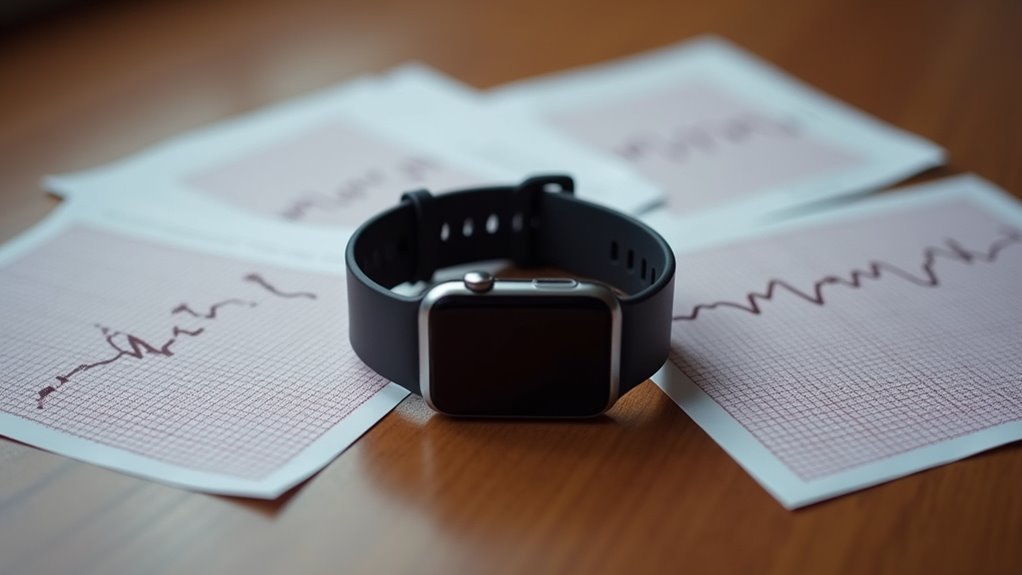
Beyond these diagnostic accuracy concerns, wearable ECG devices face fundamental technical hurdles that compromise their clinical reliability. Your smartphone, fitness tracker, and other electronic devices create electromagnetic interference that corrupts ECG signals, potentially leading to misdiagnosis.
Motion artifacts from daily activities further degrade signal quality, making consistent readings nearly impossible.
The challenges you’ll encounter include:
- Signal quality degradation – Wearable ECGs produce three quality grades: A (clinical-worthy), B (basic heart rate only), and C (unusable), with most readings falling below clinical standards.
- Environmental interference – Electromagnetic fields from nearby devices continuously disrupt signal acquisition.
- Motion sensitivity – Physical movement during recording creates artifacts that traditional filtering struggles to eliminate.
These technical limitations prevent wearable devices from achieving the controlled, high-quality recordings that clinical ECG systems consistently deliver. Unlike clinical settings where electrode storage and preparation are standardized, wearable devices cannot control for proper skin preparation or immediate electrode application after package opening.
Arrhythmia Detection Performance Across Major Smartwatch Brands
You’ll notice significant variation in arrhythmia detection sensitivity when comparing major smartwatch brands, with Apple Watch achieving 97.8% specificity while Samsung Galaxy Watch shows 85% sensitivity and specificity for atrial fibrillation detection.
These performance differences often lead to false positive challenges that can cause unnecessary anxiety or medical consultations.
However, AI enhancement benefits are increasingly addressing these accuracy gaps, with evolving algorithms improving detection capabilities across all major brands. A recent study demonstrated that all tested consumer wearable devices achieved 100% sensitivity for atrial fibrillation detection when compared against clinical-grade 12-lead ECG standards.
Sensitivity Varies by Brand
When evaluating arrhythmia detection capabilities, different smartwatch brands demonstrate varying levels of sensitivity and specificity that directly impact their clinical usefulness.
You’ll find that while some studies show 100% sensitivity across devices for detecting atrial fibrillation, real-world performance varies considerably between manufacturers.
The variations you should consider include:
- Apple Watch performance – Shows 97.8% specificity for detecting sinus rhythm, but sensitivity can drop to 85% in certain models like the Apple Watch 6.
- KardiaMobile 6L consistency – Maintains 100% sensitivity with 96.4% specificity across different testing scenarios.
- Algorithm differences – Each brand uses proprietary detection algorithms that considerably affect accuracy rates.
These performance gaps mean you can’t assume all wearable ECGs offer equivalent diagnostic reliability for arrhythmia detection.
Most devices show reasonable accuracy when measuring heart rate during rest, but this reliability significantly decreases during physical activity or exercise conditions.
False Positive Challenges
While sensitivity differences between brands create one set of diagnostic concerns, false positives present an equally significant challenge that can undermine the clinical value of wearable ECGs.
You’ll encounter these inaccurate alerts particularly with single-lead devices, which can’t capture the thorough electrical patterns that multi-lead clinical ECGs provide.
Your device’s algorithms may struggle to distinguish normal heart rhythms from actual arrhythmias, especially when you’re moving or there’s poor skin contact.
If you’re in a population with low heart disease prevalence, you’re more likely to experience overdiagnosis through false positives.
These incorrect alerts don’t just waste your time—they create unnecessary anxiety, drive up healthcare costs through unneeded medical visits, and can erode your trust in the technology’s reliability. The presence of premature beats can trigger false alarms even in people with otherwise normal heart rhythms, making the control group selection crucial for understanding real-world performance.
AI Enhancement Benefits
As artificial intelligence transforms ECG analysis in wearable devices, you’re witnessing accuracy improvements that can reach 90% for atrial fibrillation detection.
AI algorithms now surpass human cardiologists in complex rhythm classification, making your smartwatch a powerful diagnostic tool.
Here’s how AI enhancement benefits your cardiac monitoring:
- Deep Neural Networks: Your device uses DNNs trained on massive datasets to detect arrhythmias with unprecedented accuracy, providing real-time alerts for immediate medical intervention.
- Predictive Analytics: AI doesn’t just detect current issues—it predicts potential arrhythmias, optimizing your cardiac care before problems escalate.
- Continuous Learning: Your smartwatch’s algorithms continuously improve through data analysis, enhancing detection sensitivity and reducing false positives over time.
These AI-driven mechanisms guarantee you’re getting clinical-grade monitoring on your wrist. The growing acceptance of smartwatch screening reflects the 2020 European guidelines that now recognize wearable devices as effective tools for early atrial fibrillation diagnosis.
Regulatory Standards and Clinical Guideline Integration Gaps
Although wearable ECG devices have gained significant traction in consumer and clinical markets, they operate within a complex regulatory landscape that hasn’t fully adapted to their unique characteristics and capabilities. You’ll find significant gaps between regulatory standards and clinical guidelines that create challenges for both manufacturers and healthcare providers.
| Regulatory Aspect | Current State | Integration Gap |
|---|---|---|
| FDA/CE Standards | Evolving requirements | Lack specific wearable criteria |
| Clinical Guidelines | Limited wearable mention | No standardized diagnostic protocols |
| Data Management | Basic privacy rules | Insufficient interoperability standards |
| Post-Market Oversight | Traditional monitoring | Inadequate continuous data tracking |
You’ll need to navigate compliance challenges across multiple international standards while clinical guidelines struggle to incorporate these devices effectively into practice protocols. The single-lead ECG systems common in many wearables have achieved FDA approval for specific conditions like atrial fibrillation detection, yet broader clinical integration remains limited.
Real-World Monitoring Advantages of Continuous Wearable ECG Surveillance
When you shift from episodic clinical ECG monitoring to continuous wearable surveillance, you’re fundamentally changing how cardiac abnormalities get detected and managed in real-world settings.
You’ll capture irregular heart rhythms that traditional clinical visits often miss, particularly arrhythmias like atrial fibrillation that occur sporadically.
The real-world advantages include:
- 24/7 Detection Capability – Your wearable ECG monitors heart activity continuously, catching abnormalities during daily activities, sleep, and stress that clinical snapshots can’t capture.
- Wireless Data Transmission – You’ll provide healthcare providers with real-time data streams, enabling immediate intervention when dangerous patterns emerge. Modern devices maintain continuous recording even when network connections are temporarily lost.
- Enhanced Diagnostic Yield – Continuous monitoring increases your chances of detecting intermittent cardiac events by 300-400% compared to standard clinical ECGs.
Patient Education and Expectation Management for Wearable ECG Technology
Before you start using wearable ECG technology, you’ll need a clear understanding of what these devices can and can’t do for your heart health.
These are wellness tools, not diagnostic instruments for life-threatening conditions. You can monitor certain arrhythmias, but don’t expect them to detect heart attacks or other acute cardiac events.
You’ll want to understand when readings warrant medical attention versus normal physiological variations. False positives can trigger unnecessary anxiety, so maintain perspective on device findings.
Don’t over-rely on notifications or interpret benign variations as serious problems.
Establish clear communication pathways with your healthcare provider about which data to share and when to report concerning readings. Wearable ECGs use fewer leads than hospital-grade equipment, which inherently limits their sensitivity and diagnostic capabilities.
Frequently Asked Questions
How Much Do Medical-Grade Wearable ECG Devices Typically Cost Compared to Consumer Versions?
You’ll pay $200-$400 for medical-grade wearable ECG devices with FDA approval, while consumer versions cost considerably less than $200. Medical devices justify higher prices through clinical accuracy and regulatory compliance requirements.
Can Wearable ECG Data Be Legally Used in Court Cases or Insurance Claims?
You can legally use wearable ECG data in court cases and insurance claims, but you’ll need expert testimony to validate its accuracy and guarantee it meets legal standards for admissibility and reliability.
How Long Do Wearable ECG Device Batteries Last During Continuous Monitoring?
You’ll get 24 hours to 14 days of continuous ECG monitoring depending on your device. Most wearables use rechargeable lithium batteries, with patches lasting longest and chest-worn monitors requiring daily charging.
Do Wearable ECGS Work Properly for Patients With Pacemakers or Other Implants?
You’ll face potential electromagnetic interference if you have pacemakers or ICDs. Studies show mixed results – some wearables don’t affect implants, but you should consult your device manufacturer before using wearable ECGs.
Which Medical Specialties Besides Cardiology Commonly Use Wearable ECG Data for Diagnosis?
You’ll find neurology, emergency medicine, endocrinology, and sleep medicine frequently using wearable ECG data. They’re monitoring stroke patients, detecting arrhythmias in emergencies, evaluating diabetic complications, and diagnosing sleep-related cardiac issues.
In Summary
You’ll find wearable ECGs aren’t clinical replacements but powerful monitoring tools. They can’t match 12-lead systems for STEMI detection, yet they’re excellent for catching arrhythmias you’d otherwise miss. Don’t expect clinical-grade accuracy, but you’ll get valuable continuous data. You’ll need proper education about their limitations and when to seek professional care. They’re best used as early warning systems, not diagnostic devices.