Your fitness tracker can monitor far more than just running and cycling. You can track floorball’s rapid direction changes, underwater hockey’s submerged endurance metrics, and cage fighting’s strike power measurements. Wearables capture cyclocross power output, rugby sevens sprint acceleration, and synchronized swimming coordination data. They’ll measure curling precision, fencing reaction times, and even extreme sports like base jumping. These devices provide real-time feedback and performance insights that traditional coaching methods simply can’t deliver for specialized athletic pursuits.
Floorball: Fast-Paced Indoor Action Monitoring
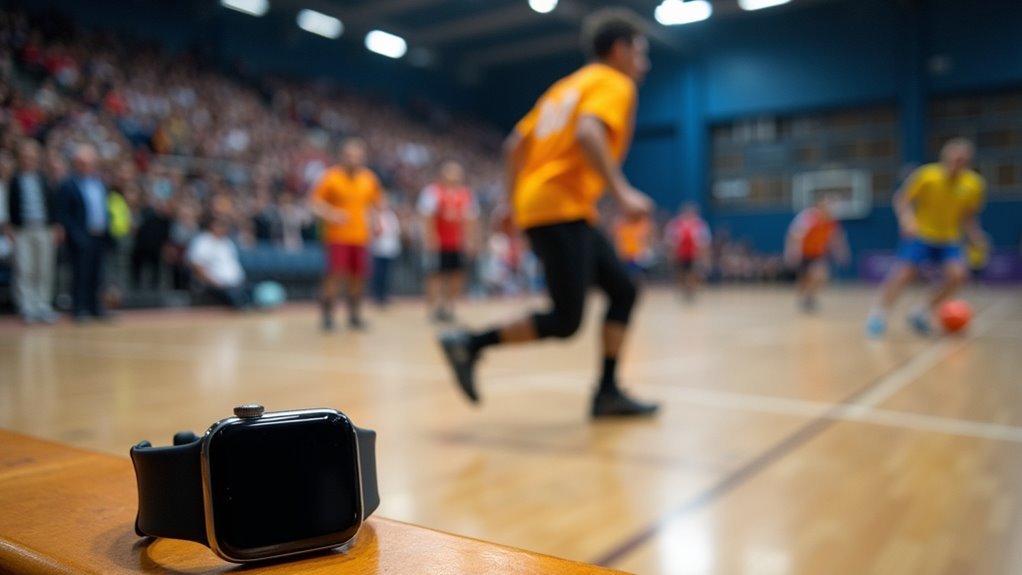
While floorball might look like indoor hockey at first glance, this fast-paced sport demands unique tracking capabilities from your wearable device.
You’ll need extensive movement monitoring as you navigate the 20 x 40-meter court through three intense 20-minute periods. Your wearable can capture rapid direction changes, quick stops, and sprint bursts that define this sport’s dynamic gameplay.
Heart rate monitoring becomes vital since you’re constantly moving with unlimited substitutions available. Your device will track distance covered, calories burned, and movement patterns as you keep one foot grounded while receiving the ball.
The stop-and-go nature of floorball, with time stoppages for penalties and goals, creates unique data intervals. Advanced tracking can even monitor your acceleration patterns and recovery rates during those important 10-minute intermissions between periods. The sport emphasizes speed and skill over strength, making it ideal for monitoring technique-focused metrics rather than pure power output.
Underwater Hockey: Submerged Performance Tracking
When you’re playing underwater hockey, your wearable must handle complete water submersion while tracking your performance beneath the surface.
You’ll need devices that can monitor your swimming speed, endurance levels, and heart rate variability as you hold your breath and maneuver around the pool floor.
Your wearable’s accelerometers become essential for analyzing your underwater movements since GPS won’t function in this aquatic environment. The sport requires continuous tracking throughout 20-minute games divided into two 10-minute halves.
Waterproof Device Requirements
As underwater hockey players glide through the depths with pucks and sticks, their wearable devices face extreme challenges that surface-based trackers never encounter. Your device must withstand crushing water pressure at various depths while maintaining complete functionality.
You’ll need materials that resist saltwater corrosion and endure impacts without compromising performance. Sensor accuracy becomes critical underwater – your tracker can’t afford to lose precision when submerged. Studies have shown that wearable devices can systematically overestimate measurements, which becomes even more problematic in underwater environments.
Real-time data transmission lets coaches make immediate tactical adjustments during games. You’ll also require extended battery life for uninterrupted tracking throughout lengthy matches.
The biggest hurdles you’ll face include developing waterproof yet sensitive sensors, creating energy-efficient systems, and designing user-friendly interfaces accessible underwater. Cost and accessibility remain significant barriers to widespread adoption.
Endurance and Speed Metrics
Once your waterproof wearable survives the pool’s harsh environment, it can capture performance data that transforms how you understand underwater hockey.
You’ll track total time spent actively engaged underwater during gameplay, monitoring breath-hold durations while maneuvering the puck. Your device records recovery intervals between underwater sprints and measures cumulative swimming distances per session.
Speed metrics reveal your average velocity during puck possession and peak swimming speeds during goal rushes or defensive actions.
You’ll analyze acceleration from stationary positions and compare underwater speeds during offensive versus defensive shifts. Heart rate variability correlates with underwater activity, gauging your exertion levels precisely.
This data helps optimize your breath-hold patterns, swimming technique, and energy expenditure, giving you competitive advantages previously impossible to measure. Your wearable can also track rolling substitutions throughout the match, helping coaches analyze player rotation patterns and optimize strategic timing for maximum team performance.
Underwater Movement Analysis
Your wearable’s motion sensors capture the intricate biomechanics that separate elite underwater hockey players from recreational participants.
Waterproof IMUs track angular changes in your shoulder, elbow, and wrist during flick movements, which dramatically differ from land-based techniques. These sensors monitor joint displacements that correlate directly with shot power and precision while you maneuver on the pool floor.
Your device measures stroke frequency, flick timing, and movement symmetry—metrics that determine puck velocity and game effectiveness.
Since you can’t wear breathing apparatus, lightweight sensors won’t obstruct your snorkel or mask. The data reveals coordination patterns and recovery movements that create tactical advantages. With over 40 countries now participating in this sport, standardized performance metrics become increasingly valuable for international competition preparation.
Combined with underwater video analysis, this information helps coaches develop personalized training programs and injury prevention strategies specific to underwater hockey’s unique biomechanical demands.
Cage Fighting: Combat Sport Intensity Measurement
When you step into the cage, your wearable device transforms into a sophisticated combat analytics system that measures every aspect of your fighting performance.
Sensors in your gloves and wrists capture real-time data on punch speed, kick accuracy, and strike power while monitoring your heart rate, blood oxygen levels, and movement patterns.
Your wearable provides objective feedback that replaces subjective coach evaluations, tracking everything from endurance to strike effectiveness. The technology alerts you to stress and fatigue levels, helping optimize training loads and reduce injury risk. Optical MoCap systems and camera tracking technologies provide additional performance data beyond wearable sensors.
Key combat metrics your wearable tracks include:
- Strike analysis – Speed, power, and accuracy of punches and kicks
- Recovery monitoring – Heart rate variability, sleep quality, and readiness indicators
- Movement patterns – Posture, positioning, and session intensity through GPS tracking
Cyclocross: Off-Road Cycling Data Collection

From the controlled environment of combat sports, we move to the unpredictable world of cyclocross, where wearable technology faces an entirely different challenge.
You’ll race through mud, snow, and freezing temperatures while your wearables collect vital performance data. Cyclocross combines road cycling, mountain biking, and steeplechase elements across 2.5-3.5 km circuits featuring pavement, grass, dirt, and sand. During these intense 40-60 minute races, you’ll dismount frequently to navigate obstacles or run up steep sections.
| Data Type | Key Metrics |
|---|---|
| Performance | Heart rate, power output, cadence |
| Navigation | GPS tracking, lap times, speed |
| Environment | Temperature, precipitation, elevation |
Your wearables track repeated anaerobic efforts, recovery periods, and consistency across multiple laps, helping you refine technique and race strategy for this demanding autumn-winter sport. The sport’s community-oriented nature means local cycling clubs often organize group training sessions where riders can compare wearable data and learn from each other’s performance metrics.
Rugby Sevens: High-Impact Team Sport Analytics
You’ll discover that rugby sevens pushes your cardiovascular system to extreme limits, making heart rate intensity monitoring vital for tracking how your body responds to the sport’s relentless pace.
Your wearable can capture sprint speed and acceleration data as you explode from rucks, chase down opponents, or break away for tries across the shorter but more intense 14-minute matches.
These metrics become essential for understanding your performance patterns in a sport where players cover significant ground at varying intensities with minimal recovery time between high-impact collisions. Modern wearables equipped with GPS trackers provide real-time distance and movement data that help optimize your positioning and energy expenditure throughout the match.
Heart Rate Intensity Monitoring
Rugby Sevens places extraordinary cardiovascular demands on players, with wearable heart rate monitors revealing just how intense this fast-paced sport really gets. Your wearable will capture mean heart rates averaging 88% of maximum throughout matches, with nearly half the playing time spent above 90% maximum heart rate.
Women’s Rugby Sevens shows particularly demanding intensity profiles, with 75% of match time at or above 80% maximum heart rate. Your device’s data will reveal significant physiological stress patterns that distinguish this sport from traditional rugby formats. Professional players demonstrate positional differences in heart rate responses, with forwards typically maintaining higher mean heart rates compared to backs during gameplay.
Key heart rate insights your wearable tracks:
- Fatigue Detection – Heart rate variability decreases and sympathetic nervous system activity increases during tournaments.
- Performance Drops – Cardiovascular output declines nearly 15% between halves.
- Recovery Planning – Data guides rest periods between matches to prevent chronic overactivation.
Sprint Speed Acceleration Tracking
While your wearable captures the cardiovascular intensity of Rugby Sevens, it’s simultaneously recording explosive movement data that reveals the sport’s unique speed demands. Your GPS vest tracks max speeds, acceleration events, and high-speed running distances that coaches use for tactical positioning and substitution decisions.
| Metric | Strategic Application |
|---|---|
| Max Speed | Identifies peak performance and fatigue levels |
| Acceleration Events | Evaluates defensive reaction times |
| High-Speed Distance | Assesses work output in demanding positions |
| Sprint Frequency | Influences player conditioning programs |
| Deceleration Patterns | Prevents overtraining and injury risk |
Your data doesn’t just measure performance—it shapes team strategy. Coaches analyze your sprint patterns to maintain formation integrity during rapid changes, while medical staff monitor acceleration spikes to prevent muscle injuries and guide rehabilitation protocols. The lightweight, breathable materials of the GPS vest ensure comfort during intense training sessions while providing vital information for performance improvement throughout the match.
Synchronized Swimming: Aquatic Coordination Metrics
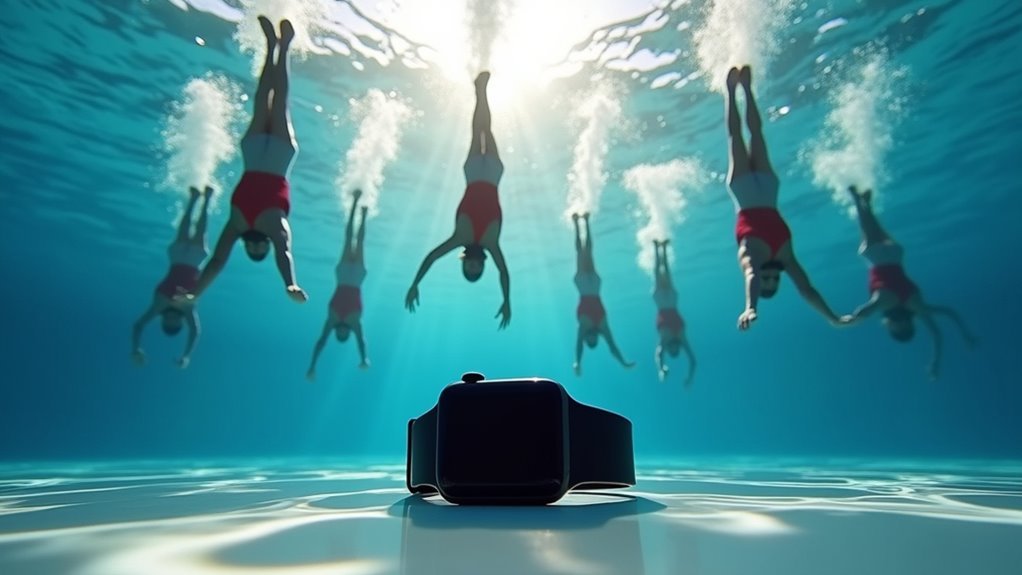
When you’re gliding through the water in perfect harmony with your teammates, synchronized swimming demands precision that goes far beyond what the naked eye can detect.
Synchronized swimming requires microscopic precision that transcends visible performance, demanding flawless coordination between teammates beneath the surface.
Modern wearables equipped with accelerometers, gyroscopes, and specialized sensors now capture the intricate metrics that separate good routines from championship performances. These devices employ low-pass filtering to enhance data quality and remove unwanted noise from motion signals during complex aquatic maneuvers.
Your swim wearables can track:
- Timing synchronization – Real-time stroke rate and pace data through augmented-reality goggles with heads-up displays, ensuring you match teammates’ rhythm perfectly during complex underwater sequences.
- Force coordination – Six-directional hand force measurements that help balance propulsion power among team members, maintaining consistent speed and aesthetic flow throughout routines.
- Spatial alignment – Three-axis motion tracking that monitors body orientation, rotations, and positioning for lifts, spins, and sculls while removing gravitational interference for precise underwater coordination.
Wheelchair Basketball: Adaptive Sport Performance Data
Your wearable can capture vital speed and acceleration data that reveals how effectively you’re pushing your wheelchair during fast breaks and defensive shifts.
These metrics help you understand your burst capabilities and sustained velocity patterns throughout the game.
Additionally, your device tracks wheelchair maneuverability analysis, measuring how efficiently you’re executing sharp turns, pivots, and directional changes that are fundamental for competitive play.
Performance tracking can also reveal shooting efficiency patterns that help identify optimal positioning and timing for scoring opportunities during gameplay.
Speed and Acceleration Metrics
As wheelchair basketball gains recognition as a high-intensity competitive sport, modern wearables can now capture the nuanced speed and acceleration data that defines elite adaptive athletic performance.
Your wearable device can track key metrics that distinguish top-tier players from recreational athletes.
The data reveals fascinating performance differences you’ll want to monitor:
- Peak velocity tracking – Elite male players reach 4.75 m/s while females achieve 4.08 m/s during sprint trials.
- Acceleration measurements – Males generate 1.32 m/s² compared to females’ 1.03 m/s² peak acceleration.
- Power output analysis – Sprint performance shows males producing 530W versus females’ 264W.
Your wearable’s inertial sensors can capture these metrics alongside rotational speed and push characteristics, providing detailed performance profiles that help optimize training and identify tactical advantages during gameplay. Players with higher functional classification scores consistently demonstrate superior speed and distance metrics, reflecting their greater trunk mobility and physical capacity.
Wheelchair Maneuverability Analysis
While speed metrics reveal raw athletic potential, your wearable’s motion sensors excel at capturing the intricate biomechanical data that defines wheelchair basketball’s tactical complexity.
Your device tracks wrist, elbow, and shoulder joint angles during maneuvers like the standard clover turn, measuring everything from push frequency to shoulder torque. This data reveals repetitive stress patterns that could lead to carpal tunnel syndrome while optimizing your technique.
Modern wearables capture distance, acceleration, and wheelchair-specific metrics like push cycles and maneuver efficiency. Research shows that passing skills are the most frequently assessed abilities in wheelchair basketball performance testing, making your wearable’s motion tracking particularly valuable for analyzing these fundamental movements.
Though accuracy varies between tracking systems—with errors ranging 2-11 degrees for joint angles—your device provides real-time feedback that improves performance monitoring.
You’ll find this longitudinal data invaluable for coaching strategies and injury prevention in adaptive sports.
Curling: Precision Sport Strategy Tracking
When most people think of curling, they envision sweeping and sliding stones across ice—but modern wearables and tracking systems have transformed this precision sport into a data-rich environment where strategy meets technology.
You’ll find systems like SPECTO Curling using LIDAR technology to analyze your throwing technique with millimeter precision. Camera-based tracking systems capture stone positions while laser velocimeters measure velocity data that’s essential for competitive performance.
Mobile apps like Klutch Curling deliver real-time feedback on your shots. These systems can measure stone positions at 5-second intervals to provide precise trajectory analysis throughout the entire delivery.
Here’s what curling tracking technology offers you:
- Stone behavior analysis – Understanding speed, rotation, and curl direction to improve your delivery
- Strategic digitization – Converting experience-based predictions into data-driven decisions
- Opponent analysis – Studying competitors’ playing styles and strategies through detailed movement data
Fencing: Sword Sport Reaction Time Analysis
Moving from ice precision to lightning-fast blade work, fencing presents one of the most demanding reaction time challenges in competitive sports. Your wearable device can track essential metrics that separate champions from competitors, monitoring heart rate spikes and movement patterns during intense blade exchanges.
Modern fencing masks incorporate sensors that provide real-time posture feedback, while your wearable analyzes reaction times across different scenarios. Simple reactions average 0.25 seconds, choice reactions 0.30 seconds, and complex reactions 0.35 seconds.
You’ll discover how VR training environments greatly improve decision-making speed, while mobile apps offer specialized reaction time games.
Your device’s data drives personalized training programs, combining agility exercises with anticipation drills. These data-driven insights can help anticipate opponents’ actions through AI and machine learning capabilities. This technology transforms traditional sword work into measurable performance optimization, giving you competitive advantages through precise reaction time analysis.
Base Jumping: Extreme Aerial Sport Monitoring
At 15,000 feet above a cliff face, your wearable device becomes a critical safety and performance tool during one of the world’s most extreme sports.
Base jumping wearables track altitude changes, descent speeds, and heart rate through accelerometers, gyroscopes, and biometric sensors integrated into lightweight gear.
Your device monitors three essential elements:
- Altitude and deployment timing – GPS sensors track jump initiation, parachute deployment, and landing phases
- Body positioning and G-forces – Gyroscopic sensors detect orientation and rotation for technique optimization
- Physiological stress indicators – Heart rate and blood oxygen levels provide real-time biofeedback
You’ll receive immediate performance feedback and data-driven insights for skill progression.
While signal loss in remote locations remains challenging, emerging smart helmet technology and AI-powered predictive analytics are advancing safety protocols for this high-risk aerial sport. Professional teams in extreme sports increasingly rely on advanced monitoring solutions to optimize athlete performance and minimize risks during training and competition.
Frequently Asked Questions
Are Wearables Waterproof Enough for Extended Underwater Sports Sessions?
You shouldn’t rely on wearables for extended underwater sports sessions. Most devices with 5ATM or IP68 ratings can’t handle dynamic water pressure, deep submersion, or prolonged underwater exposure beyond thirty minutes safely.
How Long Do Wearable Batteries Last During Extreme Sports Activities?
During extreme sports, you’ll get 10-60 hours with GPS active, depending on your device. Suunto Vertical leads with 60 hours, while cold weather and continuous display drain batteries faster than normal activities.
Can Wearables Track Performance Accurately in Sub-Zero Winter Sports Conditions?
You’ll experience reduced accuracy in sub-zero conditions, with heart rate errors up to 20% and caloric data off by 100%. Cold temperatures, thick clothing, and movement greatly degrade sensor performance despite specialized winter sports technology.
Do Wearables Interfere With Official Competition Rules in Professional Sports?
You can’t wear wearables during official professional games, but you’re allowed to use them during practice sessions. However, you can decline if your team suggests wearing them during training.
What’s the Cost Difference Between Basic and Advanced Sports Wearables?
You’ll spend $25-$100 for basic trackers that monitor steps, heart rate, and sleep. Advanced models cost $300-$1,100+ but offer GPS, multi-sport tracking, detailed analytics, and extended battery life for serious athletes.
In Summary
You’ll discover that your wearable isn’t limited to traditional sports tracking. These nine unusual activities prove you can monitor everything from underwater hockey’s breath control to base jumping’s heart-pounding descents. Whether you’re perfecting curling precision or analyzing fencing reactions, your device captures valuable performance data. Don’t let unconventional sports stop you from optimizing your training. Embrace these unique activities and access your wearable’s full potential across diverse athletic pursuits.