

You can secure your devices using ECG biometrics by implementing wearable or non-contact sensors that capture your heart’s unique electrical patterns for authentication. Install deep learning models like CNNs to extract discriminative features from your ECG signals, achieving up to 99% identification accuracy. Combine ECG with multi-factor authentication methods and use hybrid encryption protocols to protect data transmission. This creates an unforgeable physiological identifier that provides continuous monitoring and real-time liveness detection, and there’s much more to explore about optimizing this technology.
Understanding ECG Signal Uniqueness for Device Authentication
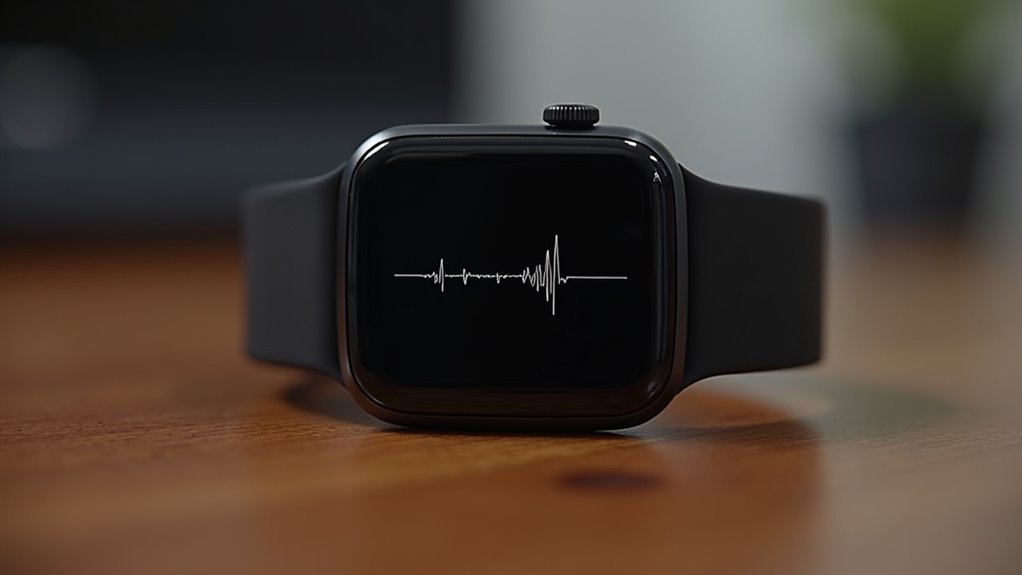
While traditional biometric methods like fingerprints and facial recognition have dominated device security for years, ECG signals offer a fundamentally different approach to authentication that’s rooted in your body’s unique physiological patterns.
Your heart’s electrical activity creates distinctive signatures based on variations in ionic potential and individual cardiac characteristics. These patterns remain remarkably stable over time, providing reliable long-term authentication capabilities.
What sets ECG biometrics apart is their inherent liveness detection – they confirm you’re alive and present, making impersonation virtually impossible. Advanced systems now integrate ECG signals with textual reports to enhance the accuracy of identity-related feature capture.
Unlike other biometrics that can be spoofed or replicated, your ECG signal can’t be forged. This resistance to spoofing, combined with the physiological uniqueness of your heart’s electrical patterns, makes ECG authentication exceptionally secure for device protection across various applications.
Choosing the Right ECG Data Acquisition Methods
When you’re selecting ECG data acquisition methods for device security, you’ll face an important decision between wearable and non-wearable options.
Wearable devices offer continuous monitoring but can feel intrusive during daily activities, while off-the-person devices provide a more natural user experience for authentication scenarios. Research shows that multi-lead systems achieve approximately 20% higher accuracy compared to single-lead configurations, making lead selection a critical factor in your implementation strategy.
Your choice directly impacts user acceptance, as reducing data intrusiveness becomes essential for widespread adoption of ECG biometric systems.
Wearable Vs Non-Wearable
How do you determine whether wearable or non-wearable ECG devices best suit your biometric security implementation?
Consider your specific use case requirements first. You’ll find wearables excel for continuous authentication scenarios where users need mobility and frequent access verification. Their 1-2 lead design achieves acceptable biometric performance with EER rates of 0.9%-7%, making them suitable for personal device security.
However, you should choose non-wearable devices when maximum security accuracy matters most. Their 12-lead systems provide superior spatial resolution and reliability in controlled environments, delivering clinical-grade precision for high-stakes applications.
Evaluate your users’ mobility needs, required security levels, and budget constraints. Wearables offer convenience but may produce increased artifacts that could affect authentication reliability in challenging environments.
Wearables offer affordability and convenience, while non-wearable systems deliver unmatched accuracy for critical security implementations.
Reducing Data Intrusiveness
Since user acceptance directly correlates with system intrusiveness levels, you’ll want to prioritize minimal contact ECG acquisition methods that balance data quality with user comfort.
Choose single-lead setups over multi-lead configurations to reduce contact points and enhance user-friendliness. While multi-lead systems capture more data, they’re considerably more intrusive and uncomfortable for users.
Implement short-term acquisitions instead of extended data collection periods. You can segment ECG signals into 3-second intervals, providing sufficient data for biometric analysis without overwhelming users.
Consider off-the-person techniques and non-invasive methods that minimize or eliminate direct skin contact. Focus on fiducial features extraction, which identifies specific heartbeat elements and has proven effective for biometric recognition while requiring less invasive data collection methods.
Leverage data augmentation and efficient feature extraction to reduce extensive collection requirements. These processing techniques introduce necessary variability while maintaining model performance, allowing you to collect less intrusive data samples without compromising system effectiveness.
Implementing Deep Learning Models for Feature Extraction
When you’re implementing deep learning for ECG biometrics, you’ll need to select neural network architectures that can automatically extract discriminative features from your acquired signals.
Convolutional Neural Networks (CNNs) excel at this task, with ResNet-50 achieving near 99% identification accuracy, while transfer learning approaches using GoogleNet or MobileNet can deliver 94-98% accuracy even with limited datasets.
You’ll also want to optimize your signal processing pipeline by transforming 1D ECG data into 2D representations using techniques like Continuous Wavelet Transform or spectrograms, enabling you to leverage powerful image-based CNN architectures. Additionally, implementing contrastive learning strategies can significantly enhance your model’s ability to differentiate between biometric signals by attracting similar samples and repelling dissimilar ones in the latent space.
Neural Network Architectures
As ECG biometrics evolve beyond traditional feature extraction methods, deep learning architectures have emerged as the cornerstone for implementing robust identification systems.
You’ll find that modern CNN architectures can achieve remarkable accuracy rates, with some studies reporting up to 99.96% on specific datasets.
When selecting neural network architectures for your ECG biometric system, consider these proven options:
- VGGNet – Offers simplicity and effectiveness in feature extraction, making it ideal for straightforward implementations.
- ResNet – Uses residual connections to enable deeper networks without vanishing gradients, considerably improving performance.
- Inception-v3 – Provides multi-scale feature extraction capabilities, perfect for capturing diverse ECG patterns.
You can also leverage transfer learning with pre-trained models like VGG16 and InceptionV3 to enhance performance while reducing training time. The Wigner-Ville distribution enables effective conversion of ECG signals into image data that neural networks can process efficiently.
Signal Processing Optimization
While traditional ECG signal processing relies heavily on manual feature engineering, deep learning models revolutionize this approach by automatically extracting meaningful patterns from raw ECG data. You’ll find these models considerably reduce time-consuming manual intervention while improving overall efficiency and accuracy.
Deep learning’s automatic feature extraction addresses ECG signals’ inherent sensitivity to noise and variability. You can optimize parameters like learning rates and biases to achieve better authentication results. The models adapt effectively to variations caused by sensor quality and environmental factors.
You’ll benefit from real-time implementation capabilities since deep learning reduces extensive training data requirements and computational resources. However, you should consider scalability challenges with large datasets.
Proper preprocessing through filtering and normalization remains essential for enhancing signal quality and maximizing your model’s performance. Skip connections in ResNet architectures help address the vanishing gradient problem common in deep neural networks processing ECG data.
Integrating Multi-Factor Authentication With ECG Biometrics
Because traditional single-factor authentication methods leave devices vulnerable to various attack vectors, you’ll find that integrating ECG biometrics into multi-factor authentication frameworks creates a more robust security foundation.
ECG biometrics serve as a physiological factor that complements knowledge-based passwords and possession-based tokens.
When you implement ECG-based MFA, you’ll benefit from:
- Enhanced liveness detection – Combining ECG with face or fingerprint biometrics provides essential verification that’s difficult to spoof.
- Reduced error rates – Score-level fusion techniques lower both false acceptance and rejection rates compared to single-modal systems.
- Layered defense mechanisms – Multiple independent biometric proofs create hybrid systems resistant to replay and forgery attacks.
Deep learning classifiers like CNNs achieve up to 100% identification accuracy, enabling real-time authentication with dynamic threshold adjustment for ideal security-usability balance. This multi-layered approach addresses the core security principle of protecting confidentiality, integrity, and availability of information stored on devices.
Protecting ECG Data Transmission With Encryption Protocols
Once you’ve established robust multi-factor authentication with ECG biometrics, you must address the next critical vulnerability: protecting the ECG data itself during transmission.
Raw ECG signals contain sensitive patient information that hackers can intercept and exploit for identity theft or unauthorized health record access.
ECG data streams carry intimate health details that cybercriminals actively target for medical identity fraud and unauthorized access to personal records.
You’ll need to implement encryption protocols that comply with HIPAA regulations while maintaining signal quality for accurate diagnosis.
Consider using hybrid encryption models that combine symmetric encryption’s speed with asymmetric encryption’s security.
TLS/SSL protocols provide standard protection for web-based transmission, while Advanced Encryption Standard (AES) offers robust protection for biomedical data streams.
For wearable devices, you should deploy lightweight encryption schemes designed for low-power environments that meet NIST requirements without compromising battery life. Advanced systems now incorporate 3D chaotic logistic maps that provide enhanced confusion and diffusion properties for securing ECG biometric templates.
Real-Time Processing Capabilities for Enhanced User Experience
After implementing secure data transmission, your ECG biometric system’s success hinges on delivering seamless real-time processing that users won’t even notice.
You’ll need sophisticated algorithms that can authenticate identities within milliseconds while maintaining accuracy.
Your system architecture should incorporate these essential components:
- Deep learning models – Deploy Convolutional Neural Networks (CNNs) and Graph Convolutional Networks (GCNs) that achieve 100% accuracy with lightning-fast processing speeds.
- Streaming data pipelines – Implement continuous learning algorithms that adapt to ECG signal variations without requiring complete system retraining.
- Modular processing design – Separate acquisition, preprocessing, and classification into parallel execution modules for maximum efficiency.
You’ll want to balance computational cost with recognition accuracy using optimized classifiers like SVMs and decision trees, ensuring threshold-based verification delivers instant acceptance or rejection decisions. The LOESS filter effectively removes baseline wandering artifacts that could otherwise compromise authentication speed and reliability.
Defending Against Data Injection and Intrusion Attacks
Three critical attack vectors threaten your ECG biometric system’s integrity: data injection attacks that simulate authentic signals, device spoofing that compromises hardware authentication, and network intrusions that intercept transmission pathways.
You’ll need layered defenses to protect against these threats.
Implement hardware-based detection systems that monitor additional biometric data beyond standard ECG patterns. Deploy software analytics that identify anomalous signal morphologies and suspicious data patterns in real-time. Secure your transmission protocols using robust encryption techniques to prevent signal interception.
Multi-layered security requires hardware monitoring, real-time analytics, and encrypted transmission protocols to defend against sophisticated biometric system attacks.
Configure extensive firewall systems and maintain regular firmware updates across all connected devices. Monitor your network continuously for unusual activity patterns that might indicate attempted breaches. Attackers can achieve 81% success rates when using authentic device data for signal injection attacks.
Verify device authenticity through multi-factor authentication protocols to prevent unauthorized hardware from accessing your system.
Balancing Security Requirements With User Convenience
While robust security measures protect your ECG biometric system from sophisticated attacks, you’ll face the ongoing challenge of maintaining stringent protection without creating friction for legitimate users.
You must strike the right balance between security and usability to guarantee widespread adoption.
Here are three key strategies to optimize this balance:
- Implement multi-factor authentication – Combine ECG biometrics with secondary verification methods to enhance security while offering users flexible authentication options that don’t compromise convenience.
- Deploy advanced deep learning models – These improve authentication accuracy and speed, reducing false positives that frustrate users while maintaining robust security standards.
- Design intuitive interfaces – Create user-friendly systems that make ECG authentication feel seamless and accessible, encouraging consistent use without sacrificing protective measures.
Modern ECG biometric systems can achieve impressive authentication accuracy rates of 91% or higher, demonstrating their viability for real-world security applications.
Expanding Applications Across Healthcare and Financial Sectors
As ECG biometric technology matures, healthcare and financial institutions are discovering transformative applications that extend far beyond basic device authentication.
You’ll find hospitals implementing ECG biometrics to enhance patient identification in medical records, dramatically improving data security and preventing unauthorized access to sensitive health information. This streamlines healthcare processes while reducing identification errors that could compromise patient safety.
In the financial sector, you can expect banks to adopt ECG authentication for secure transactions and identity verification. Since ECG signals resist forgery due to their physiological nature, they’re becoming invaluable for preventing fraud.
You’ll benefit from real-time authentication through wearable devices that capture ECG signals seamlessly. Modern implementations leverage Siamese neural networks that excel at comparing ECG inputs and assigning similarity scores to determine user identity with remarkable accuracy. These cross-sectoral implementations demonstrate how ECG biometrics provide enhanced security, convenience, and data integrity across multiple industries.
Frequently Asked Questions
What Happens to ECG Biometric Systems When Users Have Heart Conditions?
When you have heart conditions, your ECG biometric system’s accuracy drops considerably. You’ll experience reduced recognition rates, from 98% healthy accuracy down to 87-95% with cardiac diseases, affecting reliable device authentication.
How Much Does Implementing ECG Biometric Security Typically Cost for Organizations?
You’ll typically spend $2,000-$4,000 per access point for ECG biometric systems. Your total costs depend on user numbers, integration complexity, and security requirements. You’re investing more than simpler biometric methods due to sophisticated physiological processing technology.
Can ECG Biometrics Work Effectively for Elderly Users or Children?
You’ll find ECG biometrics work moderately well for elderly users, though accuracy drops with health conditions. For children, there’s limited research showing developmental changes affect signal stability and identification accuracy.
What Backup Authentication Methods Should Be Available if ECG Fails?
You should implement multi-factor authentication combining fingerprint or facial recognition with PINs or passwords. These backup methods guarantee you’ll maintain secure access when ECG sensors fail or produce unreliable readings.
How Often Do ECG Biometric Systems Need Recalibration or Updates?
You’ll need recalibration every few weeks to months, depending on your health changes, stress levels, and device performance. Regular firmware updates and template adjustments maintain accuracy as your ECG patterns naturally drift.
In Summary
You’ve now discovered how ECG biometrics can revolutionize device security through unique cardiac signatures. You’ll need to carefully balance implementation complexity with user experience while prioritizing robust encryption and real-time processing. Don’t overlook multi-factor integration and attack prevention measures. As you deploy ECG authentication across healthcare and financial applications, you’re positioning yourself at the forefront of next-generation biometric security that’s both highly secure and naturally user-friendly.


Leave a Reply