
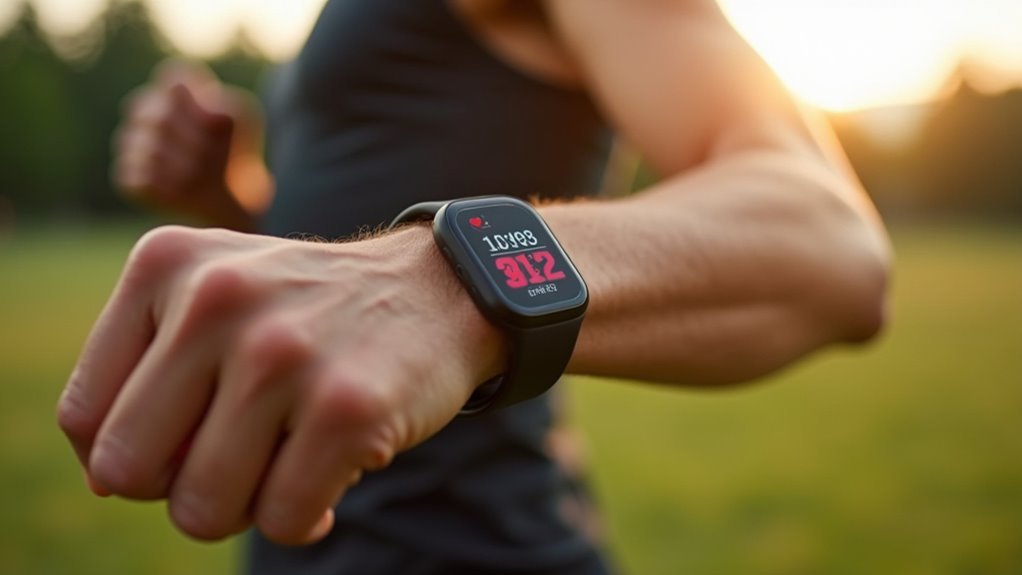
Modern sport wearables now monitor your HRV patterns to detect overtraining before performance declines, track sleep architecture for recovery optimization, and calculate acute-to-chronic workload ratios to maintain your ideal 0.8-1.3 training range. You’ll get real-time oxygen saturation feedback during workouts while machine learning algorithms analyze fatigue biomarkers like lactate and cortisol levels. These devices establish personalized training zones that adapt to your physiological state, preventing injury while maximizing performance gains through continuous multi-sensor data integration that reveals deeper insights ahead.
Heart Rate Variability Analysis for Overtraining Detection

While traditional markers of overtraining often appear after performance has already declined, heart rate variability (HRV) offers you a proactive window into your autonomic nervous system’s response to training stress.
HRV measures the variation in time between heartbeats, reflecting the balance between your sympathetic and parasympathetic nervous systems. When you’re overtraining, chronic stress elevates sympathetic activity while suppressing parasympathetic function, consistently resulting in decreased HRV.
Modern wearables enable daily HRV tracking through short-term morning measurements, providing consistent baselines for trend analysis. For optimal accuracy, HRV should be measured in a fasted morning state when you’re awake but not exercising.
You’ll notice HRV changes often precede performance declines or injury, allowing you to adjust training intensity before overtraining manifests.
Sleep Quality Metrics and Recovery Optimization
Since sleep accounts for roughly one-third of your day, it’s arguably the most essential factor determining how well you recover from training stress.
Modern wearables track key metrics including total sleep time, sleep efficiency, and wake after sleep onset to help optimize your recovery protocols. Devices like Oura Gen 2 and WHOOP 3.0 provide detailed sleep architecture analysis, breaking down light, deep, and REM sleep phases.
However, you’ll need to interpret these metrics carefully. Consumer sleep technologies typically overestimate total sleep time and sleep efficiency while underestimating sleep disruptions compared to clinical standards. Multi-sensor devices provide more accurate sleep data than single sensor alternatives, combining accelerometers for sleep/wake detection with photoplethysmography for heart rate metrics.
Despite these limitations, wearables offer practical ongoing monitoring that helps identify recovery trends and supports real-time adjustments to your sleep hygiene practices.
Acute to Chronic Workload Ratio Calculations

You’ll need to master three key calculation methods for ACWR: rolling averages, exponentially weighted moving averages, and coupled models that account for fitness and fatigue dynamics.
Your ideal ACWR typically ranges between 0.8-1.3, with values around 1.0-1.2 representing the sweet spot for performance gains without excessive injury risk.
Understanding injury risk thresholds becomes critical when your ratio exceeds 1.5 or drops below 0.5, as both extremes greatly increase your vulnerability to injury or performance decline. Research indicates that limiting weekly training load increases to less than 10% may minimize injury risk and prevent dangerous spikes in workload.
ACWR Calculation Methods
Although ACWR serves as a powerful monitoring tool across various sports, its effectiveness depends entirely on which calculation method you choose to implement.
You’ll encounter two primary approaches: Rolling Average (RA) and Exponentially Weighted Moving Average (EWMA). The RA model treats all workload data equally, averaging your acute and chronic periods without emphasizing recent sessions. However, EWMA places greater weight on your most recent training, better reflecting how your fitness actually fluctuates.
| Method | Recent Emphasis | Injury Prediction | Performance Reflection |
|---|---|---|---|
| RA | Equal weighting | Moderate accuracy | Less responsive |
| EWMA | Higher weighting | Superior accuracy | More responsive |
| RA | Static approach | Limited sensitivity | Delayed adaptation |
| EWMA | Dynamic approach | Enhanced sensitivity | Real-time adaptation |
EWMA consistently outperforms RA in representing your true performance capacity and injury risk. If you encounter technical difficulties when implementing these calculations, refreshing the page may resolve temporary glitches in your monitoring software.
Optimal Ratio Ranges
Once you’ve selected your calculation method, determining your target ACWR ranges becomes the next critical step in effective load monitoring.
Research consistently shows ideal ranges between 0.80 and 1.30 for minimizing injury risk while maintaining performance gains.
Understanding these key thresholds will guide your training decisions:
- Sweet Spot Zone (0.80-1.30): This range balances progressive overload with injury prevention, allowing steady fitness adaptations.
- High Risk Zone (>1.40): Acute spikes above this threshold dramatically increase injury probability due to excessive fatigue accumulation.
- Detraining Zone (<0.67): Extended periods below this range may protect against injury but can compromise fitness progression.
Your sport’s specific demands and competition schedule should influence these ranges.
Team sports often require more flexibility, while endurance sports may tolerate slightly higher ratios during peak training phases. Athletes with high chronic workload demonstrate superior injury resilience when maintaining moderate ACWR values.
Injury Risk Thresholds
When analyzing injury risk through ACWR calculations, understanding the specific thresholds that signal danger becomes paramount for athlete safety.
You’ll find that ACWR ratios greater than 1.0 typically indicate increased injury risk when acute loads exceed your athlete’s chronic baseline. However, research reveals a U-shaped relationship where both extremely low and high ratios can elevate risk.
You can’t rely on universal thresholds since sport-specific findings show varying risk patterns across different activities and positions.
Your monitoring approach should establish individualized baselines rather than applying generic cutoffs. While some studies suggest ratios above 1.3-1.5 present heightened danger, you’ll need to take into account your athlete’s adaptation history and current chronic workload levels. Research in elite youth football demonstrates that ACWR ratios ≥1.76 for total distance can increase contact injury risk by nearly five-fold.
Remember that ACWR serves as one component within your extensive injury prevention strategy, not a standalone predictor.
Oxygen Saturation Monitoring During Athletic Performance

You can now monitor your oxygen saturation in real-time during training and competition, providing immediate feedback on how efficiently your body’s delivering oxygen to working muscles.
This SpO2 data reveals performance bottlenecks you might miss with heart rate alone, especially when fatigue begins affecting your cardiorespiratory system.
Whether you’re training at sea level or preparing for high-altitude competition, continuous oxygen tracking transforms how you assess and optimize your physiological responses to exercise stress. During intense exercise, rising blood temperature and acidity naturally promote oxygen release to your working muscles, which your wearable device can detect through these saturation changes.
Real-Time Oxygen Tracking
The revolution in oxygen monitoring technology has transformed how athletes track their physiological responses during training and competition.
You can now access real-time oxygen saturation data through advanced wearables that use near-infrared spectroscopy (NIRS) and pulse oximetry sensors. These devices measure muscle oxygen (%SmO2) and arterial blood oxygen (%SpO2) with improved motion artifact mitigation.
Key applications for enhancing your performance include:
- Altitude adaptation monitoring – Track SpO₂ changes when training at elevation to guide acclimatization
- Training intensity modulation – Adjust workout pace based on oxygen delivery data for best conditioning
- Recovery assessment – Identify fatigue levels through post-exercise saturation values to prevent overtraining
You’ll get immediate feedback that enables personalized conditioning plans and helps detect early signs of illness or hypoxia. This real-time data eliminates the guesswork from training adjustments and provides the precision needed for optimal performance outcomes.
Performance Impact Assessment
Understanding how oxygen saturation data translates into actionable performance insights requires examining its direct correlation with athletic output and physiological thresholds. You’ll notice significant oxygen saturation decreases before reaching your anaerobic threshold, particularly during maximal exercise sessions. This data helps you identify ideal training intensities and predict muscle fatigue during extended workouts.
| Exercise Phase | Oxygen Saturation Pattern | Performance Indicator |
|---|---|---|
| Warm-up | Gradual decline from baseline | Metabolic preparation |
| Aerobic threshold | Noticeable decrease begins | Sustainable pace marker |
| Anaerobic threshold | Sharp decline accelerates | Maximum sustainable intensity |
| VO2 max | Plateau or continued drop | Peak performance capacity |
| Recovery | Gradual return to baseline | Recovery efficiency metric |
Real-time muscle oxygenation monitoring enables you to evaluate internal physiological burden and customize training adaptations based on individual reference values established during standardized testing protocols. Research with trained cyclists demonstrates that muscle oxygen saturation measurements show good reliability across varying exercise intensities when using wearable near-infrared spectroscopy devices.
Altitude Training Applications
As altitude increases, oxygen saturation monitoring becomes essential for optimizing training protocols and preventing altitude-related performance decline. Your SpO₂ levels will naturally drop as atmospheric pressure decreases—at 6,000 feet, you’re getting only 80% of sea-level oxygen pressure, while above 14,000 feet drops to just 59%.
Modern wearables from Garmin, Whoop, and Apple Watch provide continuous SpO₂ tracking, though wrist-based sensors lose accuracy during high-intensity exercise.
You’ll want to focus on:
- Spot checks during rest periods to establish baseline trends and monitor acclimatization progress
- Symptom correlation when readings drop below 90%, indicating increased altitude sickness risk
- Training intensity adjustments based on SpO₂ data to prevent overexertion and optimize adaptation
Regular monitoring helps you track physiological adaptation as your body produces more red blood cells. All collected physiological data remains protected through comprehensive data security measures implemented by monitoring platforms.
Real-Time Physiological Feedback Systems
Modern wearable devices transform how you receive physiological feedback during athletic performance by integrating multiple sensor technologies into extensive monitoring systems. Your GPS, inertial measurement units, and pressure sensors work together to compute real-time metrics like cadence and footstrike index, which algorithms analyze to determine loading on specific body segments.
| Technology | Metrics Monitored | Real-Time Benefits |
|---|---|---|
| GPS + IMU | Cadence, pace | Technique optimization |
| Pressure sensors | Footstrike patterns | Injury risk reduction |
| Heart rate monitors | Physiological load | Performance enhancement |
You’ll receive instant feedback through smartphone apps that provide personalized target zones based on your injury history and current biomechanics. This real-time data processing allows you to adjust your technique immediately, reducing injury risk while optimizing performance and maintaining motivation throughout your training sessions. The feedback system adapts to your individual motives for running, whether focused on health benefits, social interaction, or personal achievement, ensuring the guidance remains relevant to your specific goals.
Machine Learning Applications in Load Management
While traditional monitoring systems require manual interpretation of complex data streams, machine learning transforms your wearable devices into intelligent coaches that automatically synthesize information from heart rate monitors, accelerometers, gyroscopes, and pressure sensors.
You’ll experience 27% greater precision in training load management as AI algorithms identify patterns signaling overtraining or under-recovery from your long-term trend data.
Machine learning delivers three breakthrough capabilities:
Machine learning revolutionizes athletic performance through intelligent data synthesis, predictive injury prevention, and real-time training adaptations.
- Biomechanical load estimation – Calculates bone stress with less than 3% error, improving injury prediction accuracy by up to 4x
- Real-time adaptation – Dynamically adjusts training intensity based on ongoing physiological data and environmental factors
- Predictive analytics – Detects injury risk factors earlier than traditional tools, generating personalized alerts before problems develop
You’ll benefit from continuous 24/7 monitoring with automated recovery recommendations. These systems excel at tracking recovery to baseline levels and ensuring a safe return to full training and competition.
Personalized Training Zone Establishment
Beyond generic fitness zones that treat all athletes identically, personalized training zone establishment uses your individual physiological markers to create precise intensity boundaries that maximize performance gains while minimizing injury risk.
Heart rate monitoring, lactate threshold testing, and VO2max data form your aerobic zone foundation, while RPE validates these objective measurements. For strength training, velocity-based training replaces percentage-based loading with real-time bar speed feedback, creating distinct zones from maximal strength to ballistic power.
Self-paced effort tests and power profile analysis through platforms like WKO5 generate your unique thresholds. You’ll need regular retesting as fitness evolves, with auto-regulated adjustments based on daily readiness metrics. This systematic approach helps avoid overtraining while ensuring each session maintains appropriate intensity for your current fitness level.
Multi-parameter validation combining heart rate, power, and RPE guarantees accuracy while wearable integration provides continuous zone adherence monitoring.
Fatigue Biomarker Identification and Tracking
Having established your personalized training zones, you’ll discover that monitoring fatigue biomarkers transforms these zones from static boundaries into dynamic thresholds that adapt to your body’s real-time physiological state.
Fatigue biomarkers transform static training zones into dynamic thresholds that adapt to your body’s real-time physiological state.
Your wearable devices now track multiple fatigue indicators simultaneously. Sweat analysis reveals lactate and glucose levels that directly correlate with energy metabolism, while cortisol measurements indicate stress accumulation. Environmental factors like climate and temperature significantly impact the accuracy of these biomarker readings, requiring advanced algorithms to maintain precision across different training conditions.
Dual-frequency bioimpedance analysis measures intramuscular fluid changes, providing precise muscle force reduction data.
Three key biomarkers revolutionize your fatigue tracking:
- Lactate levels – indicating exercise intensity and metabolic stress
- Electrolyte concentrations – revealing hydration status and cellular function
- Heart rate variability patterns – showing autonomic nervous system response
These biomarkers predict delayed onset muscle soreness and help you optimize recovery periods, preventing overtraining while maximizing performance gains.
Frequently Asked Questions
How Accurate Are Consumer-Grade Wearables Compared to Medical-Grade Monitoring Devices?
You’ll find consumer wearables reasonably accurate for basic wellness tracking, but they’re considerably less precise than medical-grade devices, especially during movement or for clinical decisions requiring validated measurements.
What Is the Typical Battery Life for Continuous Physiological Monitoring?
You’ll find most continuous physiological monitoring devices offer 3-7 days of battery life, though some like the Oura Ring 4 can last up to 8 days depending on usage patterns and features.
How Much Does Professional-Grade Wearable Monitoring Technology Cost for Teams?
You’ll typically invest $50,000-$150,000 for complete team packages covering 10-30 athletes, plus $10,000-$50,000 annually for software subscriptions. High-end systems can exceed $10,000 per athlete yearly including maintenance.
Can Wearable Data Be Integrated With Existing Team Management Software Systems?
You can integrate wearable data with existing team management software through SDKs and APIs. Multi-device platforms support over 350 models, delivering daily insights, extensive dashboards, and real-time analytics directly to coaches.
What Privacy Concerns Exist When Collecting Continuous Athlete Physiological Data?
You’ll face significant privacy risks including potential data breaches, unauthorized access to sensitive biometric information, lack of athlete consent control, compliance challenges with global regulations, and ethical concerns over personal data ownership.
In Summary
You’re now equipped with cutting-edge wearable technology that transforms how you monitor training loads. You’ll detect overtraining through HRV analysis, optimize recovery with sleep metrics, and calculate workload ratios automatically. You can track oxygen saturation, receive real-time feedback, and benefit from AI-driven load management. You’ll establish personalized training zones and identify fatigue biomarkers before they derail your performance. You’re ready to revolutionize your athletic development.


Leave a Reply