
Your fitness tracker calculates sleep scores by combining data from accelerometers that detect movement, optical sensors monitoring heart rate variability, and algorithms that classify your sleep into wake, light, deep, and REM stages. The score typically ranges from 0-100, factoring in sleep duration, efficiency, restfulness, and consistency compared to your personal needs. However, accuracy varies between devices, with some showing 5-10% differences in sleep stage detection. Understanding these underlying mechanisms will help you interpret what those nightly numbers actually reveal about your rest quality.
How Wearable Devices Track Your Sleep Patterns
Dozens of microscopic sensors work together on your wrist or finger to decode what happens when you sleep. Your device’s photoplethysmography (PPG) sensors monitor blood volume pulse to estimate heart rate and heart rate variability throughout the night.
Accelerometers detect your body movements, while some advanced models incorporate skin temperature sensors for enhanced accuracy.
These multi-sensor approaches continuously record data to generate epoch-by-epoch sleep timelines. The algorithms analyze this combined sensor information to identify your total sleep time, sleep onset latency, number of awakenings, and sleep efficiency.
Most consumer wearables classify your sleep into broad categories: wake, light sleep, deep sleep, and REM sleep, though accuracy varies compared to clinical sleep studies. Advanced devices now include pulse oximeter capabilities to monitor blood oxygen levels and detect potential breathing irregularities during sleep.
The Science Behind Motion Detection and Heart Rate Monitoring
While these sensors collect vast amounts of data throughout the night, the real magic happens in how they actually detect and interpret your body’s signals.
Your tracker’s accelerometer contains piezoelectric crystals that convert your physical movements into electrical signals, measuring changes in velocity to detect everything from restless tossing to complete stillness.
Meanwhile, the optical heart rate sensor uses green LEDs that penetrate your skin, detecting light fluctuations as your blood volume changes with each heartbeat.
These sensors work together seamlessly. When your accelerometer shows minimal movement and your heart rate becomes steady, algorithms interpret this as deep sleep.
The gyroscope adds rotational data while the magnetometer provides orientation context, creating a thorough picture that distinguishes between actual sleep and simply lying still while awake. However, sleep tracking accuracy can be particularly challenging for individuals with insomnia.
Breaking Down Sleep Stage Classifications and Measurements
Once your fitness tracker captures all this raw sensor data, sophisticated algorithms must translate these signals into meaningful sleep stage classifications that mirror what sleep scientists have established through decades of research.
Your device typically identifies four main stages: Awake, Light sleep (combining N1 and N2 phases), Deep sleep (N3), and REM sleep.
These classifications align with American Academy of Sleep Medicine standards. Your tracker detects awake periods through movement and increased heart rate variability. Light sleep shows decreased muscle activity compared to being awake. Deep sleep reveals minimal movement and lower heart rate, essential for physical recovery.
REM sleep detection proves challenging since it’s characterized by muscle atonia with subtle movement patterns. Machine learning models trained on clinical polysomnography data enable these classifications every thirty seconds. Advanced devices collect multiple data points per second through accelerometers, gyroscopes, and optical sensors to achieve this level of precision.
Components That Make Up Your Sleep Score Calculation
Your fitness tracker transforms all these classified sleep stages into a single, digestible number through a complex scoring system that weighs multiple components of your night’s rest.
Your fitness tracker distills complex sleep data into one meaningful score that captures your complete night’s rest quality.
This thorough algorithm evaluates four critical areas:
- Sleep Duration – Your total sleep time compared to your personal sleep needs, where both insufficient and excessive sleep reduce your score.
- Sleep Quality – Sleep efficiency percentage and periods of restlessness that interrupt your restoration cycles.
- Physiological Restoration – Heart rate variability and deep sleep stages that indicate your body’s recovery progress.
- Sleep Consistency – Regularity of your bedtime and wake times that supports healthy circadian rhythms.
Most trackers scale these components from 0-100, with different platforms weighting each factor uniquely while maintaining focus on holistic sleep health assessment. Research shows that most users score between 72 and 83 on these comprehensive sleep rating systems.
Comparing Popular Sleep Scoring Systems Across Platforms
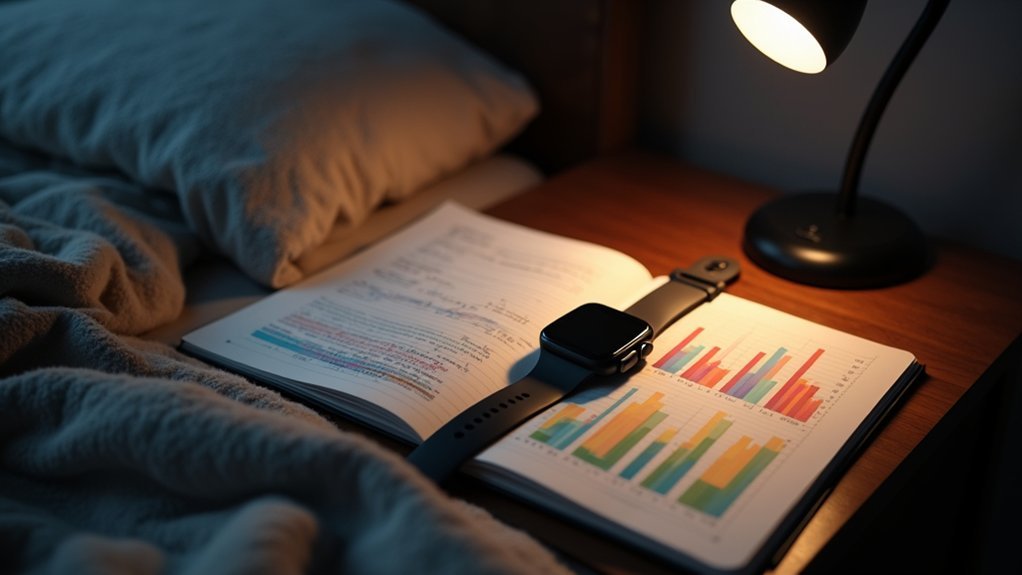
When you’re shopping for a sleep tracker, you’ll quickly discover that each platform uses drastically different scoring methodologies to evaluate your rest quality.
Your Fitbit might give you an 85 while your friend’s Garmin rates the same night’s sleep as a 72, reflecting how companies prioritize different metrics like deep sleep duration versus sleep efficiency.
These algorithm accuracy variations mean you can’t directly compare scores between devices, making it essential to understand what each system actually measures. Most trackers monitor essential metrics like sleep stages, heart-rate variability, respiratory rate, and overall sleep quality to generate their proprietary scores.
Platform Scoring Methodologies
Since fitness tracker manufacturers guard their sleep scoring algorithms as proprietary trade secrets, you can’t directly compare the underlying logic that transforms your sensor data into those nightly sleep scores.
Each platform weighs different factors uniquely. Fitbit combines heart rate variability with movement sensors, emphasizing sleep duration, quality, and disturbances. Google Pixel Watch and Fitbit Sense 2 prioritize deeper sleep stages more heavily in their calculations. Some devices integrate respiratory rate and skin temperature for enhanced accuracy.
The scoring differences that affect your sleep insights include:
- Epoch lengths – Your data’s processed in 30-second versus 60-second intervals
- Sleep stage weighting – Deep sleep might count more than light sleep
- Personalization factors – Your daytime stress and activity levels influence scores
- Fragmented sleep handling – Naps and interruptions impact calculations differently
Most devices with heart rate and actigraphy perform well at detecting total sleep time, though sleep staging accuracy remains a significant challenge across manufacturers.
Key Metric Differences
The foundation of every sleep score lies in how platforms measure and weight your core sleep metrics, yet these calculations vary dramatically between devices.
Most trackers dedicate 75% of your score to sleep stage durations—light, deep, REM, and total sleep time—but they don’t weight these equally. Some platforms heavily emphasize deep and REM sleep due to their restorative importance, while others balance all stages more evenly.
Fitbit and Apple Watch go beyond basic stages, incorporating heart rate variability and respiratory rate into their algorithms.
Oura Ring adds skin temperature fluctuations to detect circadian rhythm disruptions. The granularity matters too—30-second epochs capture brief awakenings better than 60-second intervals, affecting how accurately your sleep fragmentation gets scored. Oura Ring’s sleep staging algorithm has been validated against polysomnography sleep lab tests for enhanced accuracy.
Algorithm Accuracy Variations
Although manufacturers rarely publish their specific algorithms, independent research reveals considerable accuracy gaps between popular sleep tracking platforms.
You’ll find that Oura Ring consistently outperforms competitors with 5-10% higher accuracy in four-stage sleep classification and balanced stage estimations without considerable over- or underestimation.
Apple Watch Series 8 achieves the highest agreement among wrist-worn devices, while Fitbit devices tend to overestimate light sleep compared to clinical standards.
Here’s what you should know about accuracy variations:
- Sleep detection sensitivity exceeds 90% across most devices – but wake detection plummets to just 18-54%
- Garmin devices consistently underperform compared to other popular trackers
- Poor sleep nights reduce accuracy across all platforms considerably
- Clinical-grade validation shows moderate agreement at best – even top performers rarely exceed 60% precision
Consumer devices demonstrate proportional bias patterns where they overestimate shorter wake periods while underestimating longer ones, which can significantly affect their overall measurement reliability.
Accuracy and Validation Methods for Sleep Data
When you’re evaluating how accurate your fitness tracker’s sleep data really is, researchers use polysomnography (PSG) as the gold standard for comparison—this hospital-based test monitors brain waves, eye movements, and muscle activity to definitively identify sleep stages.
Your device’s algorithms are trained using machine learning methods that analyze movement patterns, heart rate variability, and other sensors to predict what PSG would detect.
Understanding these validation processes helps you interpret whether your tracker’s 88% overall accuracy or its struggles with deep sleep detection (around 49% accuracy) matter for your specific sleep goals. However, PSG testing is expensive and cumbersome, requiring overnight stays in specialized sleep labs with professional evaluation, making consumer trackers a more practical option for ongoing sleep monitoring.
PSG Comparison Standards
Since fitness trackers promise to decode your sleep patterns with impressive-sounding metrics, you need reliable benchmarks to evaluate their actual performance.
Polysomnography (PSG) serves as the gold standard, recording multiple physiological parameters that consumer devices simply can’t match.
When researchers validate fitness trackers against PSG, they’re measuring how well your wearable performs against thorough sleep lab equipment.
Here’s what makes this comparison so significant:
- Your sleep stages matter – Only PSG captures true REM and deep sleep through brain wave monitoring
- Breathing disorders go undetected – Trackers miss sleep apnea that PSG identifies through airflow sensors
- Movement isn’t everything – Your tracker relies on motion while PSG reads actual brain activity
- Professional scoring counts – Trained technologists interpret PSG data with standardized protocols
You’re fundamentally comparing a basic calculator to a supercomputer. The AASM Manual provides comprehensive scoring rules that ensure consistent interpretation of sleep study data across accredited facilities.
Algorithm Training Methods
Your fitness tracker’s sleep score depends entirely on the algorithms running behind the scenes, and these digital brains require extensive training to interpret the whispers your body sends through sensors.
These algorithms don’t rely on single data points—they’re trained using multi-sensor fusion, combining accelerometer data, skin temperature, heat flux, and galvanic skin response to detect sleep states minute by minute.
Machine learning models analyze massive datasets spanning months to years, learning from labeled sleep stage classifications across diverse populations.
Training incorporates both temporal and physiological signal attributes, using cross-validation and iterative refinement to reduce errors. Advanced systems integrate subjective measures like self-reported sleep quality alongside objective sensor data to improve accuracy and personalization.
The algorithms undergo continuous updates as more data gets collected, helping them distinguish between sleep stages and improve their ability to detect sleep quantity and quality with greater precision.
Key Factors That Can Affect Your Sleep Score Readings
Although fitness trackers have become increasingly sophisticated, multiple factors can greatly impact the accuracy of your sleep score readings. Your device’s technology, physical characteristics, and sleep environment all play vital roles in determining how well your tracker captures your actual sleep patterns.
Several key factors can dramatically affect your sleep score accuracy:
- Sleep disorders like sleep apnea – These conditions alter your normal sleep cycle, causing devices to overestimate or underestimate sleep stages.
- Your body mass index (BMI) – Weight differences affect how devices measure and interpret your sleep data.
- Physical activity levels – High activity can confuse trackers, making them mistake movement for wakefulness.
- Environmental factors – Noise, temperature, and light exposure influence sleep quality and tracker readings.
Sleep trackers work by detecting periods of measured inactivity rather than directly monitoring your brain activity during sleep.
Understanding these variables helps you interpret your sleep scores more effectively.
Optimizing Sleep Tracking Performance for Better Results
While understanding the factors that influence sleep score accuracy is important, taking proactive steps to enhance your tracker’s performance can markedly improve the reliability of your data.
Start by wearing your device consistently in the same location each night and make certain it’s properly charged before sleep. Keep your firmware and software updated to access the latest algorithms for more accurate sleep stage detection.
Establish a consistent sleep schedule and expose yourself to morning sunlight to regulate your circadian rhythm. Avoid late-night meals, caffeine, and nicotine before bedtime to reduce sleep disturbances. Creating a cooler environment can also enhance sleep initiation and maintenance for better tracking results.
Practice relaxation techniques like meditation or deep breathing to minimize restlessness. Configure your device correctly with accurate personal information, and wear it continuously as the manufacturer recommends for ideal data collection.
Frequently Asked Questions
Can Sleep Trackers Diagnose Sleep Disorders Like Sleep Apnea or Insomnia?
Sleep trackers can’t diagnose sleep disorders like sleep apnea or insomnia. They don’t measure brain activity, which is essential for accurate diagnosis. You’ll need professional sleep studies using polysomnography for reliable medical diagnosis.
How Long Should I Wear My Device Before Sleep Scores Stabilize?
You’ll need to wear your device consistently for about 7-14 nights before sleep scores stabilize. Your device requires time to calibrate and learn your personal sleep patterns for accurate tracking.
Why Do Different Fitness Trackers Show Varying Sleep Scores Same Night?
Different trackers use unique algorithms and sensor technologies to interpret your sleep data. They’ll classify sleep stages differently, leading to varying scores even though you’re experiencing the same night’s sleep.
Should I Sleep With My Tracker Every Night or Take Breaks?
You should wear your tracker nightly during sleep changes or concerns for thorough data. Take breaks if you experience discomfort, anxiety about scores, or become overly dependent on the device.
Can Medications or Caffeine Affect My Device’s Sleep Score Accuracy?
Yes, caffeine and medications can affect your tracker’s accuracy by altering heart rate and movement patterns. Your device may misinterpret these physiological changes as different sleep stages, potentially skewing your scores.
In Summary
You’ve now got the tools to decode your fitness tracker’s sleep scores and understand what drives those nightly numbers. Don’t obsess over perfect scores—they’re guides, not gospel. Focus on consistency, wear your device properly, and remember that how you feel matters more than any algorithm’s assessment. Use these insights to spot patterns, make adjustments, and gradually improve your sleep quality for better overall health and well-being.

Leave a Reply