
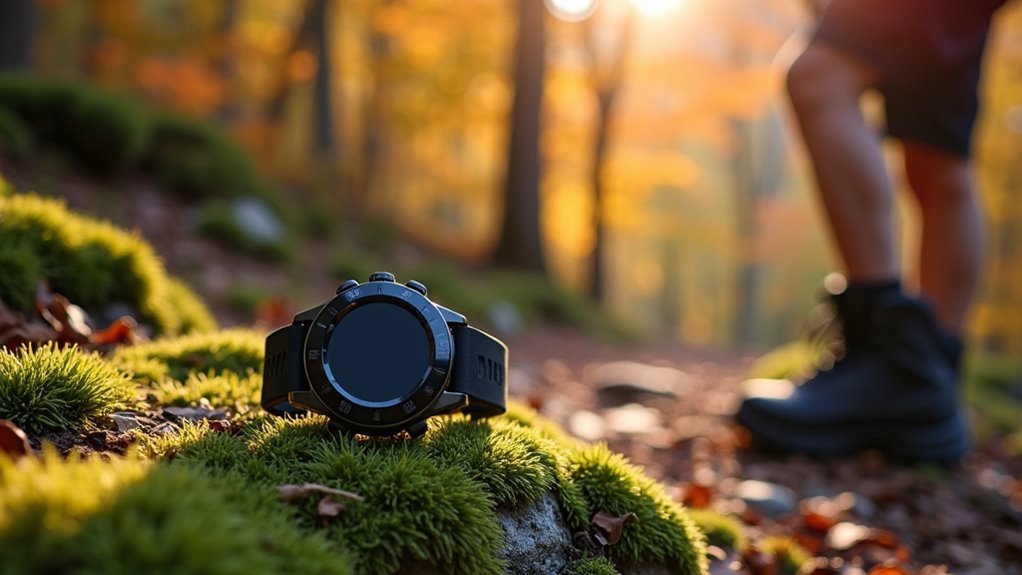
Fall detection wearables can save your life on remote hiking trails by automatically detecting falls with up to 96.3% accuracy and alerting emergency services within 28-52 seconds. The Apple Watch Ultra 2 and Garmin Fenix 7 Pro lead the market with advanced algorithms, GPS tracking, and cellular connectivity. These devices use accelerometers, gyroscopes, and AI to differentiate real falls from false alarms while providing precise location data to rescue teams. Explore the complete technology behind these life-saving devices.
How Fall Detection Technology Works in Wearable Devices

When you’re hiking on remote trails where help might be hours away, fall detection wearables act as your digital safety net by constantly monitoring your body’s movements through sophisticated sensor technology.
These devices primarily use accelerometer sensors to detect sudden changes in speed and orientation that characterize falls. Barometer sensors complement this by measuring pressure changes from altitude shifts during a fall event.
Accelerometer and barometer sensors work together to detect the sudden movement and altitude changes that signal a hiking fall.
Advanced algorithms analyze this raw sensor data to distinguish between actual falls and false alarms from normal hiking movements. Machine learning and AI increasingly enhance accuracy and responsiveness. Inertial measurement units combine accelerometer and gyroscope data to provide more comprehensive movement analysis for improved fall detection accuracy.
When you fall, the device automatically triggers alerts to monitoring centers without requiring your intervention—crucial if you’re unconscious or injured. This connectivity works through cellular networks, ensuring help reaches you even in remote outdoor locations.
Essential Sensors That Power Fall Detection Systems
Your fall detection wearable relies on three core sensors that work together to identify when you’ve taken a tumble on the trail.
The accelerometer tracks sudden movement changes, the gyroscope monitors how your body’s orientation shifts, and the barometer analyzes pressure variations that occur during a fall.
These sensors constantly collect data about your movements, creating an all-encompassing picture of your activity that can distinguish between normal hiking motions and an actual fall. Modern systems utilize machine learning techniques to analyze this sensor data and achieve highly accurate fall detection with minimal false alarms.
Accelerometer Movement Detection Technology
At the heart of every fall detection wearable lies a sophisticated accelerometer that continuously measures changes in velocity across three-dimensional space. You’ll find these sensors monitoring your x, y, and z-axis movements in real-time, instantly detecting sudden impacts or orientation changes that signal a potential fall.
When you stumble or fall, the accelerometer captures your acceleration profile and feeds this data into complex algorithms. These systems use threshold detection to distinguish between normal hiking movements and dangerous falls. Your device combines this information with gyroscope and barometer data for enhanced accuracy.
| Accelerometer Type | Detection Method |
|---|---|
| Piezoelectric | Pressure-based sensing |
| Piezoresistive | Resistance change detection |
| Capacitive | Electronic field monitoring |
| MEMS-based | Micro-mechanical movement |
However, you might experience false positives from sudden stops or environmental factors affecting sensor readings. Modern fall detection systems incorporate finely tuned algorithms that work continuously to differentiate between actual emergency situations and everyday activities that might trigger sensors.
Gyroscope Orientation Change Monitoring
While accelerometers capture linear movement changes, gyroscopes provide the critical missing piece by measuring angular velocity and rotational motion that occurs during falls.
When you fall, your body doesn’t just move linearly—it rotates and changes orientation dramatically. Gyroscopes detect these angular changes by monitoring your trunk angle shifts, helping distinguish between intentional movements like sitting down quickly and actual falls.
Your wearable device uses optimized angular velocity thresholds, typically around 240°/s, to trigger fall detection algorithms. This gyroscope data works alongside accelerometer readings to achieve impressive accuracy rates of 96.3% in some systems. The system can also integrate data from barometers to provide an even clearer picture of your status during potential fall events.
Barometer Pressure Variation Analysis
Beyond tracking rotational movement, barometric pressure sensors add an essential third dimension to fall detection by measuring rapid altitude changes that occur when you hit the ground.
High-performance sensors like the ENS220 can detect altitude drops as small as one meter in fractions of a second, while Bosch’s BMP581 sets new accuracy benchmarks for wearable applications.
These sensors complement your device’s accelerometers and gyroscopes by capturing slow falls that mightn’t trigger rapid acceleration changes.
Advanced algorithms like differential moving average filters and Kalman filters analyze pressure waveforms to identify characteristic patterns during altitude drops, reducing false alarms from normal hiking movements while ensuring genuine falls aren’t missed in challenging terrain. ScioSense has developed specialized algorithms that achieve unprecedented detection rates for environmental sensing applications.
Top Smartwatches With Advanced Fall Detection Features
You’ll find that Apple’s Watch Series leads the market with sophisticated fall detection algorithms that automatically trigger Emergency SOS when you can’t respond within 60 seconds.
The Apple Watch Ultra 2 stands out for hikers with its rugged build, 100-meter water resistance, and cellular connectivity that guarantees your distress signals reach emergency services even in remote areas.
Several other SOS-enabled smartwatches like the Garmin Fenix 7 Pro also offer fall detection paired with emergency positioning features that can save your life on challenging trails. The Garmin fenix 8 AMOLED Sapphire delivers exceptional performance with 84 hours GPS mode capability, making it ideal for extended backcountry adventures where reliable tracking is essential.
Apple Watch Series
Since introducing fall detection with the Series 4, Apple Watch has consistently led the smartwatch market in advanced safety features for outdoor enthusiasts. You’ll find fall detection across Series 4 through the latest Series 10 and Ultra 2, with each generation improving accuracy and reliability.
The technology uses accelerometer and gyroscope sensors to detect sudden falls, then alerts you with vibrations. If you’re immobilized for 60 seconds, it automatically contacts emergency services and sends your location to pre-set contacts.
| Feature | Performance |
|---|---|
| Detection Rate | 12 out of 15 actual falls |
| Simulated Falls | 7 out of 10 detected |
| Best Performance | Hard, sudden falls |
| Limitations | Gradual or minor falls |
You can customize settings and enable detection during workouts like hiking. The feature is automatically activated by default for users aged 55 and older, though younger hikers can manually enable it for enhanced safety during outdoor adventures.
SOS Smartwatch Options
Several specialized SOS smartwatches have emerged as compelling alternatives to traditional fitness-focused devices, offering dedicated emergency response features that don’t require smartphone connectivity.
The Bay Alarm Medical SOS Smartwatch exemplifies this category with AI-powered fall detection and 4G LTE connectivity through AT&T’s network. You’ll get 24/7 monitoring, precise location tracking, and a dedicated SOS button for immediate emergency calls.
Unlike fitness watches such as the Amazfit GTR 4 that need phone pairing, these devices operate independently. The user-friendly design eliminates unnecessary apps, focusing solely on safety essentials. These dedicated emergency devices help avoid false positives that may occur with fitness-oriented smartwatches during vigorous hiking activities.
Monthly subscription plans start at $39.95, providing continuous monitoring without smartphone dependency or upfront costs.
Emergency Response Capabilities During Hiking Accidents

When you’re hiking in remote areas where cell service is spotty and help can be hours away, modern fall detection wearables serve as your digital lifeline to emergency services.
These devices automatically detect falls using accelerometers and gyroscopes, then initiate emergency alerts within seconds without requiring you to press any buttons.
Two-way communication features let trained response specialists assess your condition verbally and determine whether you need immediate help or if it’s a false alarm.
GPS tracking transmits your precise location to emergency medical services, while integration with professional monitoring centers guarantees appropriate response protocols for remote hiking environments. Response times average around 28 to 52 seconds depending on the device and monitoring service provider.
The devices factor in terrain complexity and inaccessible locations when coordinating rescue operations.
Preventing False Alarms in Outdoor Environments
How can you trust your fall detection wearable on challenging trails without triggering constant false alarms?
You’ll need to understand that wrist-worn devices create more false positives due to frequent arm movements from hiking poles, gear adjustments, and dynamic activities like chopping wood or clapping.
Consider pendant or belt-clip devices instead—they’re positioned closer to your body’s center of gravity for better accuracy.
Modern wearables use sensor fusion, combining accelerometers, gyroscopes, and barometers with smart algorithms that analyze context like speed and altitude changes.
Look for devices with built-in delays that give you 5 seconds to cancel false alarms.
Cloud-based learning continuously improves detection accuracy, while advanced AI filters out natural hiking movements to recognize true fall patterns. Immediate care after a detected fall is crucial to prevent minor injuries from becoming life-threatening emergencies, especially in remote hiking areas where rescue response times are extended.
GPS Integration and Location Sharing for Rescue Operations

Although preventing false alarms keeps your device functional, GPS integration transforms your fall detection wearable into a lifeline that can guide rescuers directly to your location when seconds count.
Advanced devices like Garmin Fenix and Apple Watch use multi-satellite systems for precise positioning, even in remote terrains. When fall detection triggers, your wearable automatically shares GPS coordinates with emergency services and pre-set contacts.
These devices continuously log location data, providing rescue teams with your journey history for faster route planning. Cellular or satellite connectivity guarantees alerts transmit beyond mobile range, while manual SOS overrides give you control when needed.
This GPS integration has measurably reduced search times in documented rescue operations, making wearables essential safety tools for high-risk hiking. Modern smartwatches require extensive customization options to ensure fall detection algorithms meet the specific demands of outdoor adventure environments.
Battery Life and Durability for Extended Hiking Trips
Extended wilderness expeditions demand wearables that won’t quit when you need them most. Your device’s battery life determines whether you’ll have protection throughout your entire journey.
The Theora Connect offers 18-24 hours, perfect for day hikes, while the Apple Watch Ultra 2 extends to 35 hours with GPS tracking. For ultra-long adventures, the Coros Apex 2 Pro delivers 66 hours of continuous use.
Battery life varies dramatically across wilderness wearables, from 18-hour day hike companions to 66-hour ultramarathon endurance champions.
You’ll need devices with 30-40+ hour battery life for multi-day trips or pack portable power banks. Look for rugged construction like the Coros Apex 2 Pro’s sapphire glass and nylon band. The Theora Connect includes Smart Fall Detection technology that automatically activates when accidents occur.
Water resistance protects against river crossings and storms. The lightweight Theora Connect at 2 ounces guarantees comfort during extended wear without compromising your hiking performance.
Setting Up Emergency Contacts and Alert Customization
Your fall detection device becomes truly effective only when properly configured with the right emergency contacts and alert settings.
Start by setting up your Medical ID with trusted emergency contacts who can respond quickly during hiking emergencies. Most devices let you customize response times before automatic emergency service calls, giving you control over false alarms while making sure real emergencies get attention.
Configure detection modes based on your hiking activities—some devices offer workout-specific settings or always-on detection. For optimal functionality, ensure wrist detection remains enabled as this is essential for the device to automatically place emergency calls after detecting a fall.
Adjust countdown periods to match your preferences, and make certain location sharing is enabled so responders can find you quickly.
Test alert dismissal features so you can cancel false alarms, and choose notification types that’ll work effectively in outdoor environments.
Frequently Asked Questions
Can Fall Detection Wearables Work Without Cellular Service in Remote Hiking Areas?
You’ll face limitations since most fall detection wearables require cellular service to send alerts. However, you can use satellite-based devices or dual-mode wearables that switch between cellular and satellite connectivity for remote areas.
How Much Do Fall Detection Smartwatches Typically Cost for Hikers?
You’ll spend $199-$799 for fall detection smartwatches designed for hiking. Budget options like SOS Smartwatch cost $199 plus $10 monthly, while premium Apple Watch Ultra 2 reaches $799 with advanced features.
Are Fall Detection Wearables Waterproof Enough for All Weather Hiking Conditions?
You’ll find most fall detection wearables offer basic waterproofing for rain and splashes, but they’re not guaranteed for extreme conditions like heavy submersion or freezing temperatures during all-weather hiking adventures.
Do Insurance Companies Cover Fall Detection Wearables for Outdoor Activities?
Most insurance companies don’t cover fall detection wearables for hiking or outdoor recreation. You’ll likely need physician documentation proving medical necessity, or consider using HSA/FSA funds with proper medical justification instead.
Can Multiple Hikers Share Emergency Contacts Through Connected Fall Detection Devices?
You can’t typically share emergency contacts through connected fall detection devices yet. Most wearables operate individually, though some apps are developing group features that’d allow hikers to automatically alert each other during emergencies.
In Summary
You’ll greatly boost your hiking safety by choosing a fall detection wearable that combines reliable sensors, GPS tracking, and robust emergency response features. Don’t forget to customize your emergency contacts, test the device’s accuracy in your hiking environment, and verify it’s got enough battery life for your adventures. With proper setup and the right device, you’ll have peace of mind knowing help’s just a fall away when you’re exploring remote trails.


Leave a Reply