You’ll revolutionize your winter sports performance by tracking precise metrics like speed, distance, and biomechanical movements through wearable technology. These devices provide real-time monitoring of heart rate, body temperature, and muscle fatigue while detecting dangerous cold stress thresholds. You’ll prevent injuries through continuous analysis of skiing technique and joint loads, while receiving personalized training programs based on your specific performance data. Advanced sensors withstand extreme conditions, capturing everything from landing forces to altitude changes for exhaustive athletic insights that’ll transform your approach.
Precision Data Collection for Winter Athletic Performance

When winter athletes push their limits on snow and ice, precision data collection through wearable technology transforms how they train and compete.
You’ll gain detailed insights into your speed, distance, and acceleration through enhanced performance metrics that optimize your training programs. GPS tracking provides accurate measurements for cross-country skiing and biathlon, while accelerometer data captures movement intensity to assess impact and fatigue levels.
Your biomechanical analysis reveals movement patterns that identify potential injury risks, enabling preventive measures. Heart rate monitoring tracks cardiovascular stress during endurance sports like figure skating.
Advanced biomechanical monitoring detects injury-prone movement patterns while heart rate data reveals cardiovascular demands across winter endurance disciplines.
You’ll receive real-time feedback that helps coaches adjust training strategies based on your individual performance metrics, creating personalized training plans that enhance efficiency while reducing unnecessary exertion. The communication layer enables seamless data transmission between your wearable devices and coaching staff through wireless protocols.
Real-Time Monitoring During Cold Weather Training
While precise data collection provides the foundation for winter athletic improvement, real-time monitoring becomes your safety net during actual cold weather training sessions. Your wearable sensors continuously track heart rate, body temperature, and respiration patterns, alerting you when parameters reach dangerous thresholds that could signal hypothermia or cold stress.
This immediate feedback lets you adjust training intensity or implement warming strategies before problems escalate.
Heart rate variability data reveals your stress and recovery status, while muscle activity sensors detect fatigue from cold air exposure. These devices provide real-time information that enables immediate adjustments to training protocols based on your body’s physiological responses to cold conditions.
When combined with GPS tracking and environmental monitoring, you’ll receive instant alerts for abnormal movement patterns that indicate instability on icy surfaces.
This real-time integration helps coaches modify your sessions based on current conditions, preventing overexertion and cold-related injuries.
Injury Prevention Through Biomechanical Analysis
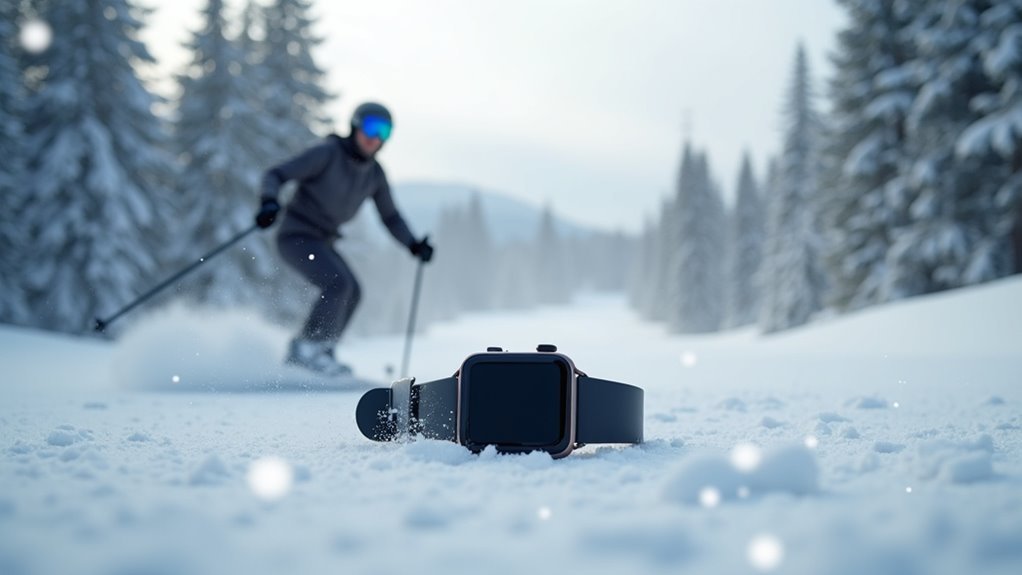
Your skiing and snowboarding technique gets analyzed in real-time through advanced wearable sensors that detect risky movement patterns before they lead to injury.
These devices monitor your joint loads, muscle activation, and fatigue levels, sending immediate alerts when you’re approaching dangerous thresholds like excessive strain rates or improper posture shifts.
You’ll receive instant feedback to adjust your form and prevent ACL tears, muscle strains, and other common winter sports injuries through continuous biomechanical assessment. Motion capture technology and wireless biosensors provide dynamic assessment of your movement mechanics to identify performance limitations and injury risks during your winter sports activities.
Movement Pattern Detection
Since winter sports involve complex, high-velocity movements that place significant stress on joints and muscles, wearable technology has become essential for detecting harmful movement patterns before they lead to injury. You’ll receive real-time biomechanical data that identifies when your technique deviates from ideal form, allowing immediate corrections.
| Technology Type | Movement Analysis | Injury Prevention |
|---|---|---|
| Force Sensors | Ground reaction forces | Joint stress assessment |
| GPS Trackers | Speed and distance patterns | Overexertion detection |
| Biometric Monitors | Heart rate during movements | Recovery optimization |
Your wearable devices establish performance benchmarks while continuously monitoring kinematic characteristics. This data helps coaches tailor training programs that address your specific movement inefficiencies. You’ll gain competitive advantages through precise movement analysis that enhances your technique while reducing strain-related injury risks. Advanced sensors capture real-time information about body dynamics, promoting immediate feedback for users to adjust daily activities and workout programs.
Fatigue Warning Systems
When fatigue sets in during winter sports, your risk of injury increases exponentially as your body’s protective mechanisms begin to fail.
Wearable technology addresses this critical vulnerability through sophisticated fatigue warning systems that monitor your biometric and biomechanical data in real-time.
These devices track heart rate variability, muscle strain through EMG sensors, and biomechanical load patterns to establish your personal fatigue thresholds.
When you exceed these predetermined limits, automated alerts immediately notify you and your coaching staff, enabling intervention before performance decrements cause injury.
You’ll receive timely warnings based on multi-sensor data rather than unreliable self-assessment.
This data-driven approach optimizes your rest and recovery windows while reducing both acute and chronic injuries linked to fatigue and overload throughout demanding winter sports seasons. Leading sports brands continuously invest in developing these advanced monitoring systems to enhance athlete safety and performance outcomes.
Real-Time Risk Assessment
While traditional injury prevention relied on post-incident analysis, modern wearable technology transforms winter sports safety through real-time biomechanical monitoring that identifies risks before they become injuries.
Your wearable devices use advanced sensors and IMUs to continuously track movement patterns, detecting biomechanical irregularities that signal potential problems. When you’re skiing or snowboarding, these systems analyze your posture, balance, and technique in real-time, alerting you to risky movements before they cause harm.
The technology enhances decision accuracy by up to 15% when selecting appropriate safety measures. You’ll receive personalized feedback that helps optimize your technique while preventing overexertion and strain. The interval-valued bipolar fuzzy programming approach ensures more precise evaluation of multiple performance factors simultaneously.
This proactive approach shifts winter sports safety from reactive treatment to preventive care, allowing you to enjoy activities with greater confidence and reduced injury risk.
Personalized Training Programs for Snow Sports Athletes

As wearable technology continues to revolutionize winter sports training, personalized programs have become the cornerstone of athletic development for snow sports athletes.
You’ll find these data-driven approaches address your specific needs while maximizing performance gains across skiing, snowboarding, and mountaineering disciplines.
Your wearable device creates customized workouts by analyzing performance metrics that matter most:
- Cardiovascular endurance patterns for sustained cross-country skiing sessions
- Strength and power outputs essential for explosive downhill runs
- Balance and coordination metrics vital for dynamic terrain navigation
- Recovery data that prevents overtraining and reduces injury risk
You’ll experience accelerated progression as real-time feedback refines your technique instantly.
This technology doesn’t just track your movements—it transforms raw data into actionable training strategies that enhance confidence, prevent injuries, and deliver sport-specific conditioning tailored to your goals. These structured workouts automatically sync with compatible devices to guide you through each training session with real-time feedback that optimizes your winter sports performance.
Advanced Sensor Technology for Harsh Winter Conditions
Though your personalized training program provides the strategic foundation for improvement, the sensors powering these insights must survive conditions that would destroy conventional electronics.
Winter sports wearables integrate advanced IMUs combining accelerometers, gyroscopes, and magnetometers to track your complex 3D movements with precision. These robust systems withstand extreme cold, moisture, and impacts through waterproof casings and thermal insulation that maintains battery life in freezing temperatures.
Impact sensors capture landing forces and collision data, enabling real-time biomechanical corrections to reduce injury risk.
Advanced impact sensors provide instant feedback on landing mechanics and collision forces, allowing athletes to adjust technique immediately and prevent potential injuries.
Barometers monitor altitude changes while physiological sensors track your heart rate using PPG technology optimized for cold-induced vasoconstriction. Modern devices also feature automatic run detection that eliminates manual intervention, allowing seamless tracking throughout your entire mountain session.
Anti-fog coatings on smart goggles guarantee clear visibility, while embedded textile sensors monitor muscle activation without restricting movement, delivering thorough performance data in harsh mountain environments.
Economic Benefits for Winter Sports Organizations
Beyond the technological prowess that enables precise performance tracking, winter sports organizations discover that wearable technology transforms their financial landscape through multiple revenue-generating opportunities.
You’ll find that implementing wearables creates substantial cost savings through injury prevention while simultaneously opening new income streams that strengthen your organization’s bottom line.
The economic advantages you’ll experience include:
- Enhanced sponsorship deals through data-driven content that provides sponsors with valuable insights and increased brand visibility
- Improved training efficiency that translates into better competitive outcomes and tournament wins
- Reduced medical costs by preventing injuries through real-time data analysis and performance monitoring
- Increased fan engagement leading to higher ticket sales, merchandise revenue, and stronger viewer attraction for live events
The wearable technology market has evolved into a multibillion-dollar industry, creating significant opportunities for organizations to capitalize on this growing sector.
These benefits position your organization for sustained financial growth.
Enhanced Fan Engagement Through Live Performance Metrics
You’re experiencing winter sports like never before as wearable technology transforms how you connect with athletes during competition.
Real-time data broadcasting puts extensive performance statistics directly in your hands, while interactive metrics let you track everything from a skier’s speed to a hockey player’s heart rate as events unfold. Physiological sensors provide crucial insights into athletes’ health and performance conditions during these demanding winter competitions.
This immersive spectator experience doesn’t just show you what’s happening—it helps you understand the physical demands and strategic decisions that shape every moment of competition.
Real-Time Data Broadcasting
When you’re watching a ski jumper soar through the air, real-time data broadcasting transforms what you see from a simple athletic display into a rich, immersive experience filled with performance insights.
You’ll receive immediate metrics capturing speed, height, jump duration, and angles through advanced motion sensors and computer vision technologies.
Real-time broadcasting delivers enhanced viewing through:
- Multi-angle replays with live data overlays showing technique and body control
- Jump-specific analytics enabling data-driven commentary during figure skating and snowboard halfpipe
- Stone trajectory visualization in curling that reveals strategic depth
- Comparative statistics providing competitive context and live rankings
You’re experiencing this technological evolution firsthand—sensor deployment increased from 4 systems in 2018 to 10 by 2022, demonstrating broadcasters’ commitment to enriching your winter sports experience. With 1.92 billion viewers tuning in globally for the 2018 Winter Olympics, this enhanced data experience reaches an unprecedented audience scale.
Interactive Performance Statistics
Four distinct layers of interactive performance statistics now transform how you engage with winter sports broadcasts.
You’ll access real-time power output data from devices like Stryd, tracking athletes’ energy expenditure as they navigate challenging terrain. Speed and distance metrics from Catapult OptimEye reveal precise movement patterns, helping you understand technique variations between competitors.
You can now analyze multi-dimensional performance data including ground contact times and injury risk indicators, giving you deeper insights into athlete safety and efficiency. Heart rate variability tracking provides additional insights into stress levels and recovery needs during competition.
Visual data displays make complex metrics accessible, letting you participate actively in sports discussions with detailed evidence.
These personalized insights create an interactive community where you’re not just watching—you’re analyzing, predicting, and engaging with extensive performance data that enhances your viewing experience dramatically.
Immersive Spectator Experience
How does real-time biometric data transform you from a passive observer into an active participant in winter sports? Wearable technology breaks down barriers between you and athletes, revealing the hidden intensity behind every performance.
You’ll witness heart rates spiking during essential moments and understand the physical demands athletes face under pressure. This transparency creates unprecedented engagement through:
- Live stress metrics that help you appreciate competitive conditions
- Real-time heart rate tracking during races that builds suspense
- Instant performance statistics that reveal athletic effort intensity
- Second-screen companion apps for personalized athlete comparisons
You’re no longer just watching—you’re experiencing the competition through data-driven insights that make every jump, turn, and sprint more compelling and relatable. These marginal gains in understanding athlete performance can transform how spectators perceive and connect with winter sports competition.
AI-Driven Analytics for Competitive Advantage
As winter sports become increasingly competitive, AI-driven analytics are transforming how athletes and coaches approach performance enhancement. You’re witnessing a revolution where wearable technology outputs fuel machine learning algorithms that predict ideal pacing strategies and performance trends from historical data.
Nearly four out of five professional sports organizations now maintain dedicated data analysis staff focused on these insights. You’ll gain critical competitive advantages through enhanced decision-making, detailed performance metrics, and reduced injury risks. Real-time feedback allows coaches to adjust race-day strategies instantly, ensuring continuous adaptation during competitions.
Wearable devices monitor biomechanical patterns to detect early warning signs of overuse injuries or improper technique, allowing for proactive adjustments before problems develop.
| Traditional Methods | AI-Enhanced Approach | Your Advantage |
|---|---|---|
| Gut feeling decisions | Data-driven insights | Precision strategy |
| Generic training plans | Personalized enhancement | Peak performance |
| Reactive adjustments | Predictive modeling | Proactive edge |
| Limited feedback | Real-time analytics | Instant adaptation |
Overcoming Implementation Barriers in Winter Sports
While AI-driven analytics promise transformative results for winter sports performance, you’ll face significant hurdles when implementing these sophisticated wearable systems.
Success requires addressing multiple barriers simultaneously through strategic planning and stakeholder engagement.
Strategic planning and stakeholder engagement are essential for successfully navigating the complex barriers of AI-driven analytics implementation in winter sports.
You can overcome these implementation challenges by focusing on these key strategies:
- Build stakeholder consensus by involving athletes, coaches, and administrators in decision-making processes from the start.
- Secure diverse funding sources through sponsorships, grants, and budget reallocation to offset high technology costs.
- Establish thorough training programs that educate users on maximizing wearable technology benefits and proper usage.
- Implement robust data protection protocols ensuring privacy compliance and transparent communication about data collection practices.
The indoor winter sports market demonstrates the potential scale of implementation, with China’s indoor facilities valued at $8.1 billion in 2023 across over 800 ski resorts, showing how comprehensive technology adoption can transform entire market segments.
Frequently Asked Questions
How Does Wearable Tech Battery Life Perform in Freezing Temperatures?
Your wearable’s battery life decreases considerably in freezing temperatures as cold slows chemical reactions and reduces capacity. You’ll need specialized freezer-rated batteries or frequent replacements since standard batteries shut off at -20°C.
What Happens to Wearable Device Accuracy During Snowstorms or Blizzards?
Your wearable device’s accuracy drops considerably during snowstorms. Heavy snowfall weakens GPS signals, moisture interferes with sensors, and electromagnetic activity disrupts data transmission, causing location errors and delayed readings.
Can Wearable Sensors Track Performance Through Multiple Winter Clothing Layers?
You can track performance through multiple winter clothing layers because advanced wearable sensors use precision technology that penetrates fabric barriers, though you’ll experience reduced accuracy with excessively thick layers interfering with signals.
How Do Athletes Clean and Maintain Wearables Exposed to Snow and Ice?
You’ll need to gently brush off snow with soft cloths, air dry thoroughly without direct heat, use protective cases, and regularly check water-resistance seals to maintain your wearables’ performance.
Are There Specific Wearable Brands Designed Exclusively for Winter Sports Conditions?
You’ll find Oakley Airwave and Recon Snow 2 Display are specifically designed for winter sports. They’re built with heads-up displays, GPS tracking, and cold-weather durability that standard wearables can’t match.
In Summary
You’ll find that wearable tech transforms your winter sports experience by delivering precise performance data, preventing injuries, and creating personalized training programs. You’re getting real-time insights during cold weather conditions while organizations benefit economically through enhanced fan engagement. You’ll gain competitive advantages through AI analytics, though you’ll need to address implementation challenges. Ultimately, you’re investing in technology that’ll revolutionize how you train, compete, and connect with winter sports.