You’ll revolutionize your swim training with waterproof bone conduction devices that deliver real-time voice commands from coaches while maintaining natural hearing awareness. These IP68-rated systems support multiple channels for team management, allowing instant stroke corrections without breaking your rhythm. The open-ear design prevents discomfort while ensuring clear underwater audio transmission through cheekbone vibrations. Hypoallergenic materials and streamlined builds reduce drag while providing secure, comfortable fits. Discover advanced customization options and troubleshooting techniques to optimize your aquatic performance.
Understanding Bone Conduction Technology for Swimmers
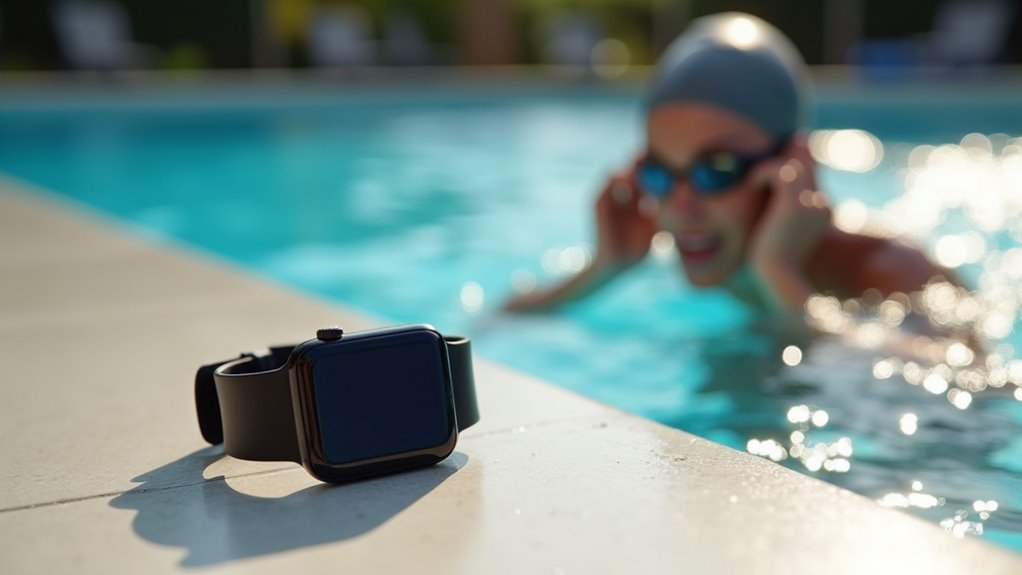
While traditional waterproof headphones struggle with sound clarity underwater, bone conduction technology revolutionizes how swimmers experience audio during training. These innovative devices transmit sound vibrations through your cheekbones directly to your inner ear, completely bypassing your eardrums and middle ear. You’ll maintain natural hearing continuity while enjoying clear audio underwater.
Unlike traditional earbuds that block your ear canals, bone conduction headphones rest securely on your cheekbones, allowing you to hear ambient sounds like coach instructions, pool signals, and fellow swimmers.
This open-ear design enhances your safety and situational awareness during training sessions. You won’t experience the discomfort or water trapping common with in-ear devices, making them perfect for extended swim workouts while maintaining both performance and comfort. The technology was originally developed for hearing aids, making it particularly beneficial for athletes seeking enhanced audio experiences during aquatic training.
Essential Voice Command Systems for Pool Training
Building on bone conduction technology’s foundation, modern voice command systems transform how coaches communicate with swimmers during training sessions.
You’ll find the Retekess TT120 leads with its IP68 waterproof rating and multi-channel capability, supporting up to 9 simultaneous operations without interference.
The SONR Swim Coach Communicator delivers crystal-clear underwater commands through bone conduction, while SwimTalker System combines audio training with precise feedback mechanisms.
Revolutionary underwater communication systems deliver instant coaching feedback through advanced bone conduction technology, transforming traditional swimming instruction methods.
These systems enable real-time coaching corrections without stopping your training flow.
You’ll experience improved technique development, enhanced safety protocols, and increased training efficiency. With SONR’s superior signal receiving depth of 1m, you’ll receive clear communication even during deeper swimming sessions.
Whether you’re focusing on competitive swimming strokes or water polo strategies, these voice command systems maintain durability in demanding pool environments while providing the immediate guidance you need for peak performance development.
SONR Receiver Setup and Configuration Guide
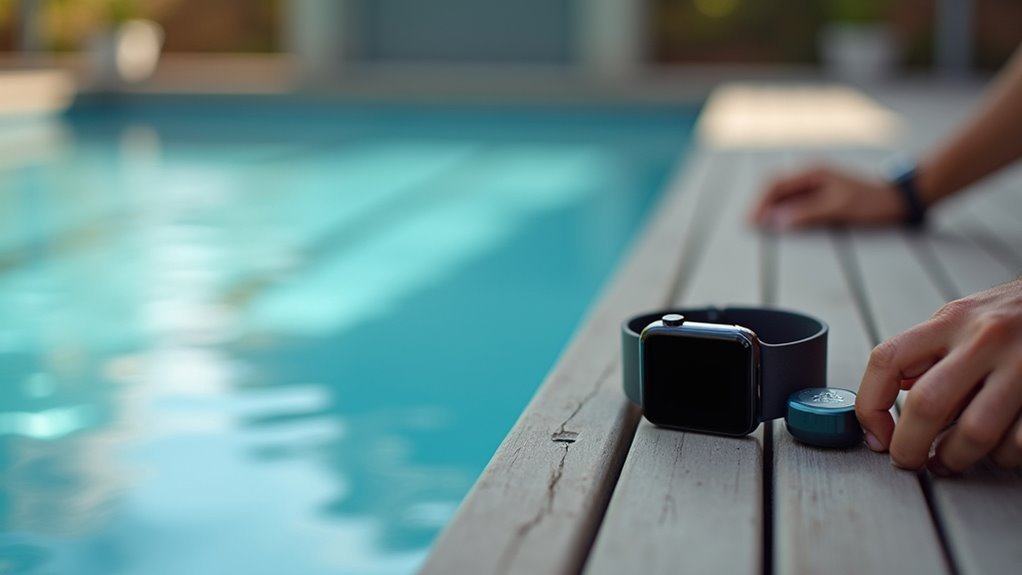
As you unpack your SONR Receiver, you’ll notice its sleek, lightweight design prioritizes comfort during extended training sessions.
You can position it under your swimming cap or attach it to your goggles using the special clip provided.
The system operates on 6 different channels, enabling versatile communication options.
You’ll configure channels by triple-pressing the receiver to check or change your current setting.
Your coach’s radio transmitter can connect to unlimited receivers simultaneously, while up to 5 coaches can operate in the same pool without interference.
After each session, you’ll need to rinse the receiver with fresh water and dry it thoroughly with a towel. The magnetic charging cable connects easily to begin the approximate 1 hour charging cycle required for full battery restoration.
This simple maintenance routine guarantees peak performance across all water environments, from chlorinated pools to saltwater conditions.
SwimTalk Headset Features and Capabilities
You’ll find SwimTalk headsets transform your training sessions through seamless real-time communication between coaches and swimmers.
The system’s 12-channel capability lets you manage multiple swimmers simultaneously, ensuring each athlete receives personalized feedback without interference.
With bone conduction technology and up to 1000-meter range, you can deliver clear instructions that swimmers hear distinctly even underwater. The ergonomic design ensures comfortable extended use during lengthy training sessions.
Real-Time Coach Communication
The SwimTalk headset revolutionizes pool communication by combining bone conduction technology with waterproof design, allowing coaches to deliver crystal-clear instructions directly to swimmers’ ears while they’re underwater.
You’ll receive immediate feedback on your technique, pace, and form without interrupting your training flow. The system’s multiple FM channels allow coaches to communicate with individual swimmers or entire teams simultaneously, eliminating the need for poolside shouting.
With transmission ranges up to 1000 meters, you’ll stay connected throughout large training facilities. The ergonomic headset design provides comfort during extended sessions, while volume controls let you personalize your listening experience. The headset features an antibacterial coating that ensures hygienic use across multiple training sessions.
Coaches can provide real-time corrections, helping you maintain proper pace and technique. This technology streamlines team management and creates a more efficient training environment for everyone involved.
Multi-Channel Swimmer Management
When managing multiple swimmers across different skill levels, SwimTalk’s 12 FM communication channels transform how you organize training sessions. You’ll operate within the 76.8–86.8 MHz frequency range, separating communication streams for distinct training groups without signal overlap.
Picture these scenarios:
- Beginner group on channel 1 receiving stroke fundamentals while advanced swimmers on channel 5 practice race strategies.
- Separate lanes using different channels during busy pool sessions, preventing instruction confusion.
- Multiple coaches managing their squads simultaneously in the same training facility.
You can switch channels quickly as training needs evolve, maintaining clear communication pathways. This channel separation enables efficient instruction delivery across various skill levels, ensuring each swimmer receives targeted guidance. The system’s bone conduction technology delivers crystal-clear audio transmission even in challenging underwater environments.
Whether you’re coaching club teams or elite squads, multi-channel management streamlines organized, professional training sessions.
Real-Time Coach Communication During Workouts
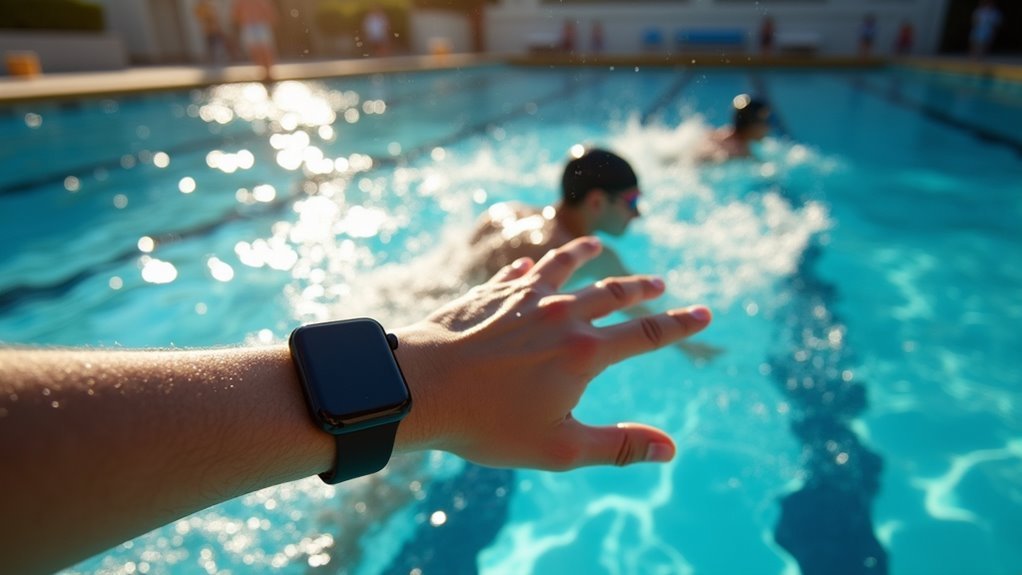
While traditional poolside coaching requires swimmers to stop and listen at lane ends, bone conduction headsets now enable coaches to deliver instructions directly into athletes’ ears during active swimming.
You’ll receive immediate feedback on stroke technique, pacing adjustments, and motivational cues without interrupting your workout flow. The FM radio transmitters support operating ranges up to 200 meters, letting coaches communicate across large pools or open water sessions.
This real-time communication eliminates the need for shouting, creating a quieter training environment while maximizing your focus.
You won’t need to rely on visual signals or stop mid-lap for instructions. The systems facilitate precise timing for interval sets and drills, helping you optimize workout intensity. Advanced systems operate on 7 different channels, allowing multiple teams to train simultaneously with separate coaching communications.
Safety improves dramatically since coaches can instantly alert you to hazards or training plan changes during sessions.
Managing Multiple Swimmers With Voice Channels
Managing large swim teams requires sophisticated communication systems that extend far beyond individual coach-swimmer interactions.
You’ll find that multi-channel voice systems revolutionize team management by offering 6-9 dedicated channels, allowing you to coordinate different training groups simultaneously without interference.
These systems let you strategically organize swimmers through:
- Skill-based channel assignment – placing beginners on channel 1 while advanced swimmers train on channel 3
- Dynamic group switching – moving relay teammates to a shared channel for synchronized starts
- Individual corrections – isolating one swimmer’s technique feedback without disrupting others
You can support unlimited swimmers per channel while accommodating up to 5 coaches managing their respective groups.
This eliminates cross-talk and maintains clear instructions, ensuring your training sessions run efficiently without constant interruptions or shouting across the pool deck. The bone conduction technology delivers crystal-clear voice commands directly to swimmers underwater, maintaining communication quality regardless of pool acoustics.
Underwater Audio Feedback for Technique Correction
Though traditional poolside coaching requires swimmers to stop and listen at the wall, underwater audio feedback transforms technique correction by delivering real-time instructions directly to swimmers while they’re mid-stroke.
You’ll receive immediate guidance on body position, stroke mechanics, and timing without breaking your training rhythm.
Bone conduction technology bypasses your eardrums, ensuring clear sound transmission underwater. Devices like SONR receivers and Swimbuds create watertight seals while maintaining comfort during extended sessions.
Advanced bone conduction devices deliver crystal-clear underwater audio while maintaining secure, comfortable fit throughout intensive training sessions.
Your coach can communicate through radio transmitters, providing instant corrections as you swim.
This real-time approach enhances your body awareness and spatial understanding. You’ll make technique adjustments immediately rather than waiting for poolside feedback, making training sessions more productive and efficient while building confidence in your stroke development. The instant feedback enables immediate corrections that help swimmers take responsibility for their own improvement during practice.
Voice-Activated Training Timer Controls
Despite current market limitations in voice-activated swimming technology, emerging timer control systems promise to revolutionize how you’ll interact with training equipment during pool sessions.
While existing devices like Tempo Trainer Pro rely on audible beeps and systems like SONR use bone conduction technology, the gap in voice activation creates opportunities for innovation.
Voice-activated controls will transform your training experience through:
- Hands-free interval adjustments – You’ll modify timer settings mid-workout without touching devices.
- Real-time routine programming – Custom workouts can be created through spoken commands during practice.
- Synchronized group coordination – Multiple swimmers will receive personalized audio cues simultaneously.
Integration challenges exist with current Bluetooth-enabled systems, but future developments will likely incorporate advanced materials and expanded functionality to overcome technical barriers. Modern swim timers offer three training modes including stroke rate, pace times, and strokes per minute for comprehensive workout customization.
Pressure Sensor Integration With Audio Cues
When pressure sensors merge with audio feedback systems, you’ll gain unprecedented insight into your swimming mechanics through real-time depth monitoring and stroke phase detection.
These waterproof MEMS sensors, like Bosch’s BMP384, integrate seamlessly into wrist-worn devices to capture underwater dynamics essential for training optimization.
You’ll receive instant audio cues when reaching preset depth zones or stroke phases, helping maintain technique consistency throughout your workout. The system triggers voice commands based on pressure thresholds, alerting you to turn shifts and breathing timing adjustments.
This hands-free communication enhances your stroke efficiency while providing safety alerts for abnormal depth conditions. The compact gel package design provides superior protection against chlorinated pool water and salt water exposure during extended training sessions.
Coaches can dynamically adjust your training regimens using real-time pressure data, optimizing underwater phases and reducing overall swim times through precise audio-guided feedback.
Open Water Swimming Voice Command Range
When you’re coaching swimmers in open water, you’ll need extended range communication systems that maintain clear audio transmission across distances of 120-200 meters.
Your signal clarity becomes critical as water conditions, environmental noise, and radio frequency limitations can greatly impact how well your voice commands reach swimmers.
You’ll also want multi-swimmer channel management capabilities using 7-12 available FM channels, allowing you to communicate with individual swimmers or groups without interference from other coaches operating nearby. The bone conduction technology enables swimmers to receive your instructions while maintaining their natural hearing and awareness of surrounding water conditions.
Extended Range Communication Systems
Open water swimming presents unique communication challenges that standard poolside coaching methods simply can’t address.
You’ll need extended range communication systems that deliver clear voice commands across vast distances without compromising your training quality.
Modern systems like the Swimtalk H900A provide up to 1000-meter range, while the Retekess TT120 offers 120 meters surface communication.
You can manage multiple swimmer groups simultaneously through multi-channel capabilities supporting up to 9 distinct training groups.
Key features you should prioritize include:
- Waterproof receivers with IP68 ratings for prolonged submersion
- Bone conduction technology preserving environmental awareness underwater
- Multi-channel coordination enabling seamless group management without cross-talk
These systems eliminate vocal strain while maintaining real-time feedback, ensuring you receive consistent coaching guidance regardless of distance or water conditions. Professional aquatic communication systems typically include one FM transmitter paired with multiple bone conduction receivers, providing comprehensive training coverage for entire swim groups.
Open Water Signal Clarity
Signal clarity determines whether your voice communication system will perform reliably in challenging open water conditions.
You’ll face water attenuation that reduces command clarity over distance, with typical real-world range between 120–200 meters depending on your device and conditions. Saltwater’s conductivity disrupts signals more than freshwater, while surface chop and wave action interfere with wireless transmission.
Ambient noise from waves and wildlife affects your audio reception, causing signal fragmentation that leads to garbled commands. Your device’s FM technology and dual microphones help improve clarity, but speech recognition remains limited due to water interference.
Temperature variations influence performance and battery life, while obstacles like boats further degrade range and clarity in challenging environments. Multi-language support ensures voice commands can accommodate swimmers from different linguistic backgrounds during international training sessions or competitions.
Multi-Swimmer Channel Management
Managing multiple swimmers requires dedicated frequency channels that prevent communication overlap and guarantee each athlete receives clear, personalized commands during open water training sessions.
You’ll assign unique channels to individual swimmers or groups, enabling customized instruction without interference. Your wearable device lets you toggle between channels instantly, while coaches can broadcast emergency commands across all frequencies simultaneously.
Key channel management features include:
- Real-time channel switching – You’ll seamlessly shift between communication frequencies using waterproof controls on your headset.
- Personalized command delivery – Your assigned channel receives tailored pacing and directional instructions specific to your training goals.
- Emergency broadcast override – All swimmers receive critical safety alerts regardless of their current channel selection.
Advanced systems log communication data for post-swim analysis, helping optimize your training effectiveness. Open water swimmers appreciate the welcoming community aspect of shared communication systems that help build connections among participants.
Wearable Device Comfort and Durability Standards
When you’re selecting a wearable device for swim training with voice commands, comfort and durability standards become critical factors that’ll determine both your performance in the water and the device’s longevity.
| Comfort Features | Durability Standards |
|---|---|
| Hypoallergenic silicone materials prevent skin irritation | Chemical-resistant construction withstands pool chemicals |
| Adjustable straps guarantee secure fit across body types | Waterproof seals protect internal electronics |
| Streamlined design reduces drag and water resistance | Replaceable parts extend overall device lifespan |
| Soft edges minimize pressure points during extended use | Regular cleaning maintains peak performance |
You’ll want devices with breathable materials that allow moisture escape while maintaining their lightweight design. Look for smooth surfaces that won’t chafe during longer training sessions, and verify the device meets World Aquatics compliance standards for competition use.
Advanced wearable models should offer real-time tracking features that provide immediate performance data during your swim sessions, helping you make instant adjustments to your technique and pacing.
Voice Command Customization for Different Strokes
You can create stroke-specific voice command sets that automatically adjust your wearable’s tracking parameters when you switch between freestyle, backstroke, breaststroke, and butterfly.
These customized commands let you access personalized instruction protocols tailored to each stroke’s unique biomechanical requirements and technique points. The voice command system is designed to detect natural speech, so you don’t need to use exact phrases when giving stroke-specific instructions.
Your device will recognize stroke-specific cues like “elbow catch” for freestyle or “dolphin timing” for butterfly, delivering targeted feedback without interrupting your training flow.
Stroke-Specific Command Sets
Each swimming stroke demands distinct biomechanical movements, and voice command systems adapt accordingly by offering specialized instruction sets tailored to freestyle, breaststroke, butterfly, and specialty strokes.
Your freestyle commands emphasize rhythmic breathing coordination with prompts like “High elbow catch” and “Exhale underwater.” You’ll hear corrections for common errors: “Avoid crossing midline” and “Maintain body alignment.”
Breaststroke sets focus on timing with cues like “Glide longer” and “Kick-and-pull coordination,” while ensuring stroke legality through “Two-hand touch” reminders.
Butterfly commands synchronize your arm pulls with dolphin kicks through prompts like:
- “Powerful pull and quick recovery”
- “Breathe every two strokes”
- “Don’t pause mid-stroke”
Specialty strokes combine elements for energy conservation during tactical swimming scenarios, guiding your posture and streamline positioning. Advanced analysis tools can integrate with wearable devices to provide real-time feedback during these stroke-specific training sessions.
Personalized Instruction Protocols
Modern voice command systems go beyond generic stroke instructions by analyzing your individual swimming patterns and creating customized instruction protocols tailored to your specific needs.
These protocols adapt based on your stroke type, whether you’re perfecting freestyle technique or mastering breaststroke timing.
Your wearable device integrates seamlessly with voice commands, providing real-time feedback that adjusts to your progress and goals.
Advanced data analysis tools examine your swimming metrics to enhance command effectiveness, offering stroke-specific guidance that targets your unique weaknesses.
You can customize commands to match your learning style and training focus, while adaptive training plans modify automatically based on your performance.
The system’s feedback mechanisms help you adjust pace, body positioning, and form, ensuring each voice prompt delivers maximum impact for your improvement. Modern training platforms provide performance analytics that complement voice command systems by offering deeper insights into your swimming development.
Troubleshooting Common Audio Communication Issues
When water interferes with your swim training audio, you’ll likely encounter several frustrating issues that can disrupt your workout flow.
Poor speaker performance occurs when water pressure dislodges your headphones or creates drag resistance. You’ll also experience audio feedback delays as real-time coaching instructions struggle to transmit through underwater conditions.
To resolve these problems quickly:
- Tap your speakers firmly to dislodge trapped water that’s causing muffled sound
- Reset your device’s audio membranes by playing loud music for 30 seconds
- Check your Bluetooth connection since water blocks wireless signals between devices
Choose bone conduction technology for superior underwater performance, as it bypasses water interference entirely. Navigate to your Samsung Health app to disable unwanted voice announcements that may interrupt your swimming session.
Guarantee your headphones fit securely before diving in, and contact support services when basic troubleshooting steps don’t resolve persistent connectivity issues.
Maximizing Training Efficiency Through Voice Technology
You’ll transform your pool sessions when voice technology enables seamless real-time coaching communication between you and your instructor.
Managing multiple swimmers becomes effortless as you can switch between dedicated audio channels to receive personalized guidance without disrupting others’ training.
Your technique improves instantly as coaches deliver immediate corrections through voice commands, allowing you to adjust your form mid-stroke rather than waiting until the end of your set. The bone conduction technology keeps your ear canal open so you maintain awareness of pool sounds while receiving clear coaching instructions.
Real-Time Coaching Communication
Although traditional swimming training relies heavily on post-interval feedback and poolside coaching, real-time voice command systems are revolutionizing how coaches communicate with swimmers during active training sessions.
These underwater communication systems enable you to receive instant feedback while swimming, creating a continuous loop of performance enhancement that wasn’t possible before. The rhythmic pattern of voice commands helps swimmers maintain consistent stroke timing and breathing cadence throughout their training sets.
The technology transforms your training experience through:
- Immediate stroke corrections – You’ll hear coaching cues the moment your technique needs adjustment, preventing bad habits from developing during long sets.
- Real-time pacing guidance – Voice commands help you maintain ideal speed throughout intervals without waiting for split times.
- Biomechanical feedback – Instant analysis of your power balance and efficiency lets you make corrections mid-stroke rather than after completing the full distance.
Multi-Swimmer Channel Management
Modern swim teams face a complex challenge when multiple swimmers train simultaneously in the same pool.
You’ll find that multi-channel voice systems like the TT120 Swim Talk solve this problem by providing up to 9 distinct channels for simultaneous communication. You can switch between channels to deliver personalized instructions to individual athletes without creating cross-talk interference.
When you need collective instructions, simply tune swimmers to the same channel for synchronized group sessions. This eliminates shouting across the pool while ensuring clarity even underwater.
You’ll maximize productive training time since real-time voice delivery reduces downtime compared to traditional visual signals. Channel switching allows seamless integration of group-specific adjustments during ongoing drills, optimizing timing and flow throughout your training sessions. Automated reminders can be programmed to guide swimmers through complex drill sequences without requiring constant coach intervention.
Instant Technique Correction
When swimmers receive immediate stroke corrections through underwater voice commands, they can adjust their technique without breaking rhythm or stopping mid-lap.
Your coach’s voice reaches you through bone conduction technology, delivering precise adjustments for arm positioning, kick timing, and breathing patterns while you’re submerged.
This real-time feedback transforms your training efficiency by eliminating the traditional stop-start cycle of poolside corrections.
You’ll experience continuous improvement as technical adjustments happen instantly, allowing you to feel the difference immediately.
Three key technique corrections you’ll receive include:
- Arm positioning: “Reach further forward” or “Keep your elbow high”
- Kick timing: “Faster kick tempo” or “Deeper leg drive”
- Breathing rhythm: “Turn your head less” or “Exhale underwater”
Your performance metrics improve faster when corrections occur during active swimming rather than between sets.
The device operates effectively underwater with an IPX8 waterproof rating that ensures reliable communication even at training depths up to 3 meters.
Frequently Asked Questions
Can Voice Command Devices Be Used in Chlorinated Pools Without Damage?
You can’t safely use most voice command devices in chlorinated pools. Chlorine degrades seals and corrodes electronics, even on water-resistant models. Look for explicitly “pool-proof” devices with chlorine resistance.
Are These Systems Compatible With Existing Swim Team Management Software?
You’ll find limited compatibility between voice command systems and swim team management software. Most platforms don’t integrate directly, so you’ll likely need to manually transfer data from voice sessions into your team’s management system.
What Is the Typical Battery Life During Extended Training Sessions?
You’ll get 16 hours from FORM Smart Swim goggles during continuous use, while Garmin Swim 2 lasts about 3 days with typical sessions. Apple Watch needs daily charging after frequent swim tracking.
Do Voice Command Devices Work Effectively in Saltwater or Ocean Environments?
You’ll find voice command devices struggle in saltwater due to corrosion risks and acoustic distortion. Most aren’t officially saltwater-certified, so you’ll need thorough freshwater rinsing and careful maintenance.
Are There Age Restrictions or Safety Concerns for Young Swimmers?
You’ll face age restrictions starting around 6 months for swimming lessons. Young swimmers need constant adult supervision, proper safety gear like life jackets, and medical clearance for health conditions to prevent drowning risks.
In Summary
You’ve got the tools to revolutionize your swim training with voice command technology. Don’t let poor communication hold back your performance—invest in quality bone conduction devices that’ll withstand pool conditions. Set up your SONR or SwimTalk system properly, customize commands for your stroke technique, and you’ll see immediate improvements. When technical issues arise, you’re ready to troubleshoot quickly. You’re now equipped to maximize every training session through seamless coach-swimmer communication.